Friday, 5 June 2015

A day of wonder and fun at the Humber Arboretum!

We had a wonderful time visiting the Humber Arboretum. Our full day trip consisted of exploring the forest and the many things it had to offer. We also had the opportunity to learn more about ponds and the many creatures that make it their habitat.

The highlight of the trip for me was the forest exploration. The natural environment was breathtaking and allowed students to explore whatever they wanted. We had a wonderful guide that explained many features of the forest to us, and was open to answering the students' many wonder questions. It seemed that there was an expectation that students be around the guide listening as she informed us about things. But I noticed that students were so excited to explore things on their own; stopping frequently that I decided to give students the choice of following the guide if they were interested in what she was showing, and/or exploring their own fascinations with their parent group leaders. The students were looking so closely and noticing such detail in their findings that it was difficult to stay as a whole group. This seemed to work out very well. Students wanted and needed to use their senses and were so motivated to investigate when something caught their eye. There was enough freedom to explore on their own but still gathered as a group for important things our guide wanted us to notice. I thank our guide for being so flexible with us and allowing the students to seek their own interests. They had wonderful questions and our guide was knowledgeable in answering them for us. She was very impressed with how engaged the students were. 

Being able to explore things freely allowed for so many inviting and interesting things to be studied and shared with others who were noticing different things. There was no need for extra materials to entice students. The forest was one big provocation with infinite possibilities to discover!

Look closely at the many things students found fascinating along the way!


We made it! 

 
 On our walk to the forest, a mother skunk carrying the baby in her mouth! 

The wonder of it all! Look up! What do you see?  

Students stopped many times as they found interesting discoveries! 

Students noticed some trees were cut down. We were told they were old and diseased. New ones were planted.  

A highlight, especially for me! Look carefully...what do you see in the hole? 

How big is this tree? Let's measure it!   

Trying to push the tree over but it's too strong! 

J. K. noticed this peculiar feature on the tree. Our guide told us to look at the bottom. Seems like an insect started eating it. 

We saw a few of these on some of the trees. We learned they are QR (Quick Response) Codes. If scanned with a mobile device, it give you information about the tree. 

Look closely up in the tree! He was sleeping and didn't even hear us! 

Learning about the river we saw. 

J. K. and M. O. noticed that the tree was cut and had lines on the inside. 

A ginormous worm! 

Happy children! They just broke out into skipping!  

E. E. documenting his experience. What created the hole in this tree?  

What better way to explore and learn about this tree than to go through it, feel it, smell it, touch it! 

K. W. seemed to enjoy her experience! 

Students noticing another creature as we crossed over the ramp. 

"What's this?" O. S. Our guide told us it was a fungus growing on the dead tree. 

Another great way to explore a dead tree this big! 


Our guide found a caterpillar!  

Running, skipping, jumping! I've never seen the students so happy and uninhibited!

The second part of our trip was learning about ponds. It was a bit more structured but involved enough to support students' curiosity and allow them to investigate creatures that live in the pond with a hands on approach.


We learned that this is duckweed. It is a food source for some birds, fish, and ducks. 

Looking and listening... 

What do you see in the water? Look closely! 

Looking at creatures we scooped up using our nets. 

A Ramshorn snail! 

Using the nets to scoop us some creatures to investigate. 

W. E. documenting his pond experience.

Experiencing nature in such a way creates memories that last a lifetime.

Thank you Humber Arboretum for the wonderful trip!

Also, a big thank you to all of our parent volunteers!

Wednesday, 3 June 2015

A small moment that led to a big creation!

I had the privilege of attending The Sunflower School's Mystery of Materials Reggio Inspired Conference a few weeks ago. The learning was inspiring and highlighted the many uses that materials can have in fostering and extending creativity and imagination in early learners. 

The process of creativity is not one in which children have to dedicate themselves to through persistence and hard work. When materials are present and accessible to children you will see acts of radical genius emerge. 


Vea Vecchi, Children, Art, and Artists
From the presentation by Brianne Bongiovanni
www.bambinicreativi.com

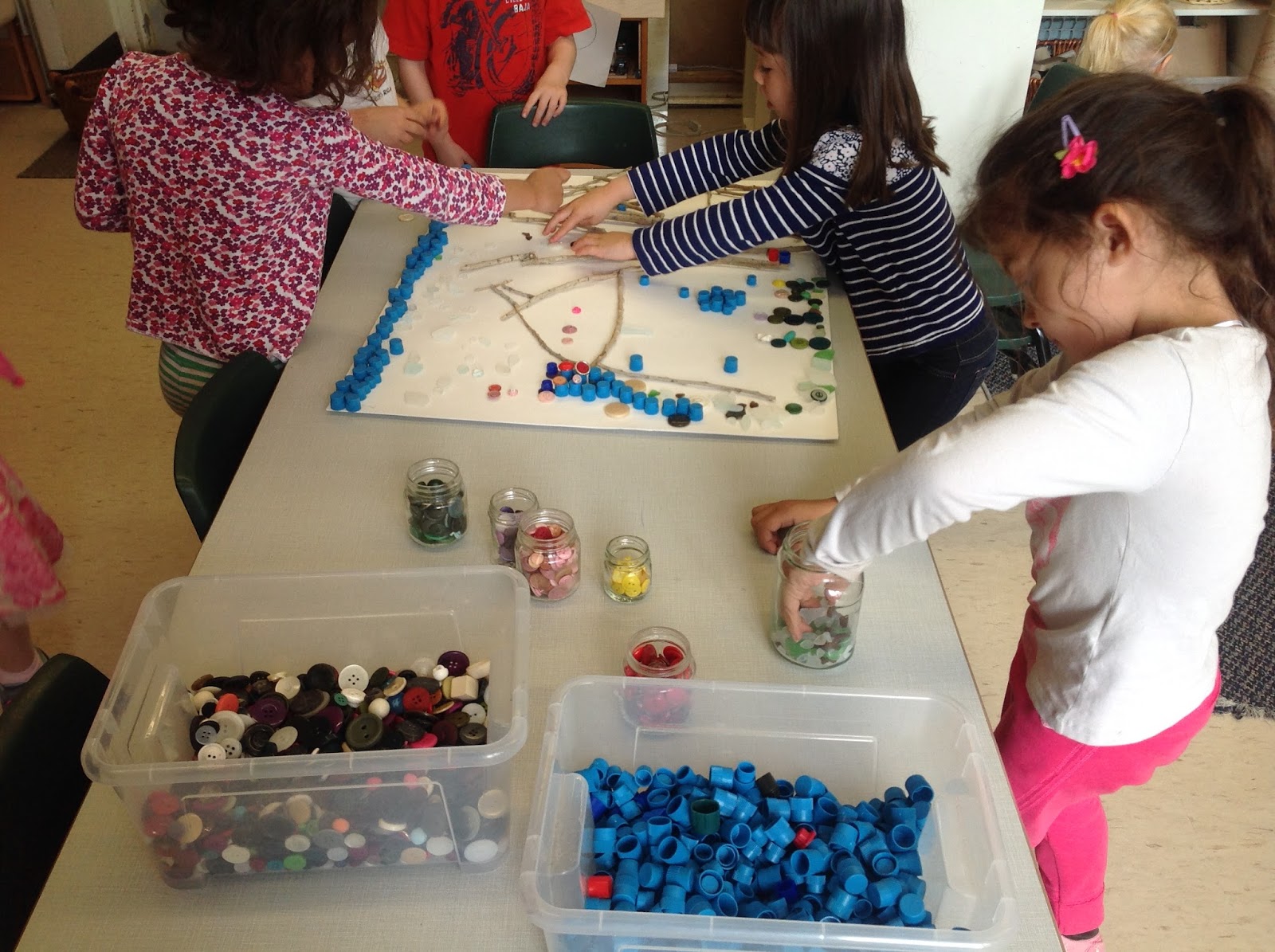
I was fortunate to capture the starting of a wonderful creative piece between two girls (S. T. and L. B.) during our Thinking and Learning Time. As I walked by I noticed they were using crayons to create pictures. Placing them point to point horizontally, vertically, and diagonally. I found it interesting that they used crayons and manipulated them in such a manner to create in a very different way than they were intended.


I asked them what they were doing and they told me they were making a house and shapes with crayons.

"I think I made this with crayons when I was a baby. I wanted to show L. B." S. T.

I decided to ask them if they wanted some bristle board paper so they can create on that using some of the Art Studio materials. They were very excited about this! I was surprised how quickly they planned out their collaborative creation. No glue was used, they simply placed their pieces on the paper and kept adding more detail by placing the materials in different ways. Their dialogue was very minimal. As I observed them work, they seemed to agree on what the art work was going to be, but then each started creating on their side of the paper. Watching them gave me visions of dancers perfecting their choreography. Each piece placed had a purpose and complimented the art piece.  


I asked them how they got the idea to create this?

"Yea, we were just playing with crayons and then you saw it and got us paper. We thinked about it in our head." L. B.

"The blue things are windows. This one here is what turns the door." L. B.

Over the few days that it took them to finish their collaborative art piece, they purposely selected and added new materials, providing more detail to their work.


Some students became intrigued and asked if they could do this too? They were always welcomed by the two girls, but again, there was no dialogue as to what they could or couldn't do. They joined the dance by watching what others were doing, getting a sense of what the creation was all about. 

The more I observed them work, the more I realized that this piece was not about the right or wrong way to place the materials but rather about the collaboration, inclusiveness, and peer support that this art piece provided to all students who joined in.


As new students flowed in and out creating small sections of the art work, the two girls remained constants, continuing their work until completion. 


I supported their work by suggesting that if they wanted to preserve it, they could use glue to stick the materials onto the paper. It was their choice.


I'm sure you wonder what the explanation for this collaborative art piece is? I asked the two girls this question.

"It's very noisy in the city. There's lots of people, it's very sunny and the sky is everywhere. there's pretty flowers and people like to go to places like the grocery store." L. B.

"This is my house and this is L. B.'s house. There's a butterfly and the green things are flowers. We have a lot of things in our city. We worked together because we know how to do cities and towns." S. T.


What are intelligent materials?
  • Highlights children's thoughts and ideas, as opposed to focusing on the actual material
  • Have multiple uses, sometimes even infinite possibilities 
  • Provoking
  • Can be used in any space in the classroom or school
  • Support student's learning and thinking
From the presentation by Brianne Bongiovanni
www.bambinicreativi.com

Questions to ponder:


What learning do you see having taken place in creating this art piece?

How can one create an environment that encourages children to feel confident and safe to express themselves creatively?

How can one support children who are new to working and creating with open ended materials?


Sunday, 17 May 2015

A bunny and its nest in our playground!

It is not the language of painters
but the language of nature which one should listen to....
The feeling for the things themselves,
for reality, is more important than the feeling for pictures.
-Vincent van Gogh

Last Child in the Woods: Saving our Children from Nature-Deficit Disorder


In my experience a natural phenomenon has had the power to spark some amazing investigations! In this case, a bunny and it's nest were identified in our playground which created quite a stir of excitement, wonder, and empathy by the children! I was just as excited but also surprised that we were able to experience such an incredible event in an urban environment. It was a magical few days which I am so grateful that the children and I were able to be a part of.

What follows is a snapshot of our encounters and learning from the bunnies in our playground.


It's important to note that we had to do our experiment twice. The first time we attempted, the string was not found the next day. Some of the students thought that birds took it to make their nests, or the mommy bunny took it inside the nest with her. Others said the wind blew it away. It could be that someone removed the string not knowing what its purpose was. We tried it again. This time, the following morning students noticed that the "X" looked the same as when we placed it the day before. We took a picture of it as instructed by the Toronto Wildlife Centre which would help us remember what it looked like. We concluded that the mommy bunny was not coming back for the bunnies anymore. We knew that this was an option because the Toronto Wildlife Centre told us that when the bunnies are 3 to 4 weeks old, they are old enough to be left on their own.

"The mom didn't come back so the babies are old enough to be by themselves." K. W.


Students remained interested in the bunnies even after school was over. They were not only fascinated to continue observing them, but had some concern about the safety of the bunnies being all alone with so many people and predators around. S. C. and his mom decided to check on the bunnies one evening after attending Beavers. The observations and video they shared with the class was amazing and once again, magical!

S. C.'s observations:

"The one that came out of the nest was more curious than the others." 

"There's more action in the night because the bunnies sometimes are awake at night." 

"We saw the bunny eating leaves." 

Bunnies in the playground! Thanks to S. C., family, and friends for allowing us to share this video with our learning community!


We continue to investigate our wonders and have begun to make distinctions between rabbits and hares. We also figured out that our bunnies are Cottontails. Here is H. S.'s thinking from some books and a pamphlet we read together in class, as well as in speaking with our expert friends.


After a few days, our bunnies were gone. We looked daily for them but it seems they became independent and started their own journey. But last week we got a glimpse of one who was hiding in our class flower garden! This time the students were quiet and spoke in low voices. They didn't get too close knowing that it would scare the bunny. They watched and wondered why this one remained...

Teaching children about the natural world should be treated 
as one of the most important events in their lives.
-Thomas Berry

Last Child in the Woods: Saving our Children from Nature-Deficit Disorder

Saturday, 9 May 2015

Building an earth caring classroom community: Part 2

Students have continued to keep a tally of the number of days our kitchen waste has been in our compost hole. Once a week, we dig it up, make observations, then turn it a few times before burying it back up.


First time digging up the kitchen waste in the compost hole.

One morning, J. K. handed me a bag full of garbage that him and F. D. picked up on the weekend in the school park. 

"I went for a garbage walk with my mom and my scooter and the big bag was attached to my scooter, that's where the bag came from." J. K.

I was so pleased to see the learning being driven by students and extended beyond the school walls.  

I felt this was a perfect authentic opportunity for students to observe the type of garbage that J. K. and F. D. found and sort it into the correct containers.

As I pulled out item by item out of the bag, students had some amazing things to say:

"Straws are bad for birds! Their beaks can get stuck in them." M. S.

"Bands are bad for dogs and other animals." F. D.

"Wow! The recycling is overflowing!" E. E.

At this time, O. S. made a great suggestion!

"Let's make a tally!" 


Once we were done sorting the items in the bag, I asked students what they thought the tally told us?

"Recycling is the most and kitchen waste is the least." A. F.

"There is still a lot of garbage." C. D.

"If we put everything in the garbage more air will get polluted and get really stinky." O. S.

"The landfills are getting bigger if we don't sort!" J. K.

"When I go to school and I bring plastic bags I take them home and my mommy and daddy reuse them for something." P. I.

I decided to ask the class the question: 

How much garbage would we have if we didn't sort it? 

I was curious to see how they would solve this problem. A few students decided to take on this challenge and share their solution with the class. 


On Friday May 8th, our compost tally chart told us that our kitchen waste has been in our compost hole for 25 days! As we have done every Friday, a group of interested students went out with a shovel and we dug up our kitchen waste to make some observations.


We noticed changes happening in our compost hole! We will continue to dig up and make observations. Fingers crossed we will have some rich soil soon!

During the first time we dug up our compost hole, excitement filled the air as we stumbled upon a few worms at the bottom of our hole! And so began a small investigation about worms.

The following are pictures of the worm investigation documentation which is also placed in the classroom for our students and visitors to see!


Having had a conversation with students about how long our worms have been in our classroom, everyone agreed they needed to be placed back in their natural habitat. Back they went exactly where we found them, at the bottom of our compost hole!

"Now they have food! They can eat our rotten food!" R. S.