Showing posts with label Snapshots of our Learning. Show all posts

Sunday, 8 November 2015

Exploring, investigating, and creating: Learning more about ourselves and each other!

We strive to provide children with a learning environment that encompasses explorations, investigations, open, guided and explicit instruction. We try to meet the individual needs of our learners which are all unique in their abilities, learning styles, and background experiences. But most importantly it is through play that children develop and learn important skills such as self-regulation.

Self-Regulation
"The abilities of children to regulate their own emotions, behaviours, and attention increase over time with maturation, experience, and responsive relationships. Supporting self-regulation is a central focus of early development because self-reguation skills lead to physical, social, emotional, behavioural, and cognitive competence."
The Full-Day Early Learning Kindergarten Program

According to The Full-Day Early Learning Kindergarten Program: Self-regulation is central to a child's capacity to learn. It is "a cornerstone of development and a central building block of early learning" (Charles Pascal, Every Child, Every Opportunity: Curriculum and Pedagogy for the Early Learning Program, p. 4). The ability to self-regulate, or to set limits for onself, allows a child to develop the emotional well-being and the habits of mind, such as persistence and curiosity, that are essential for early learning and that set the stage for lifelong learning. Self-regulation involves attention skills, working memory, and cognitive flexibility-qualities that provide the underpinning for essential skills needed throughout life, such as planning and problem-solving skills (ibid., p. 4). Self-regulation allows children to have positive social interactions and sets a pattern of behaviour that will benefit them throughout their lives. Social, emotional, and cognitive self-regulation and the ability to communicate with others are foundational to all forms of learning and have been shown to be best developed in play-based environments (p. 7., 2010-11).

"It has long been acknowledged that there is a strong link between play and learning for young children, especially in the areas of problem solving, language acquisition, literacy, numeracy, and social, physical, and emotional skills. Young children actively explore their environment and the world around them through a process of learning-based play."
The Full-Day Early Learning Kindergarten Program

I hope you enjoy these moments of learning from the past few months and I hope you view them through a new lens!

M. S. reading the poem Pick a Pumpkin to his classmates! As students walk into class each morning, they each take turns reading classroom poems to each other until everyone has signed in. I love seeing them take turns, share the reading, and help each other out with reading. They have gotten to the stage where this is all done independently. 

F. W. playing a matching numbers game with B. P.!

C. C. and A. R. playing a new math game together!

Quickly! Guess how many dots!

These two students decided they wanted to create some yoga poses for the class! They modeled it after the book "I AM YOGA". 


This area is used by students when they are tired or would like to engage in calming activities. A wonderful space supporting self-regulation.

C. D. decided she wanted to go to our yoga area and practice some yoga poses.

One day I asked the students what we can do to "grow our learning?" The red dots are what they came up with during our discussion. 
I noticed that some students never attempted some things and chose to just say they couldn't do it. This has become a wonderful support for all our learners!

Everyone is a mentor in our classroom because everyone is good at something! But being able to ask for help is key! Here is C. C. placing a piece of paint paper up for M. K. so he can paint.

Painting at the easel takes a lot of skill! But we have such wonderful mentors that it's become quite simple for some of our new friends to learn! We have many brushes to choose from and many paint colours that the students created themselves! We stress how important it is to have an idea first before starting so that one knows what type of brushes and colours will be needed!

Here is a look at the cleaning process after one is done painting at the easel! Lots of brushes to clean, re-filling the jar with fresh water, and placing everything back in the proper place for the next person. Well done C. T.!

A gorgeous day for a neighbourhood pumpkin tally walk!

S. T. and L. B. creating a pattern together using natural materials from our Rock Garden.


Playing teacher at the easel!

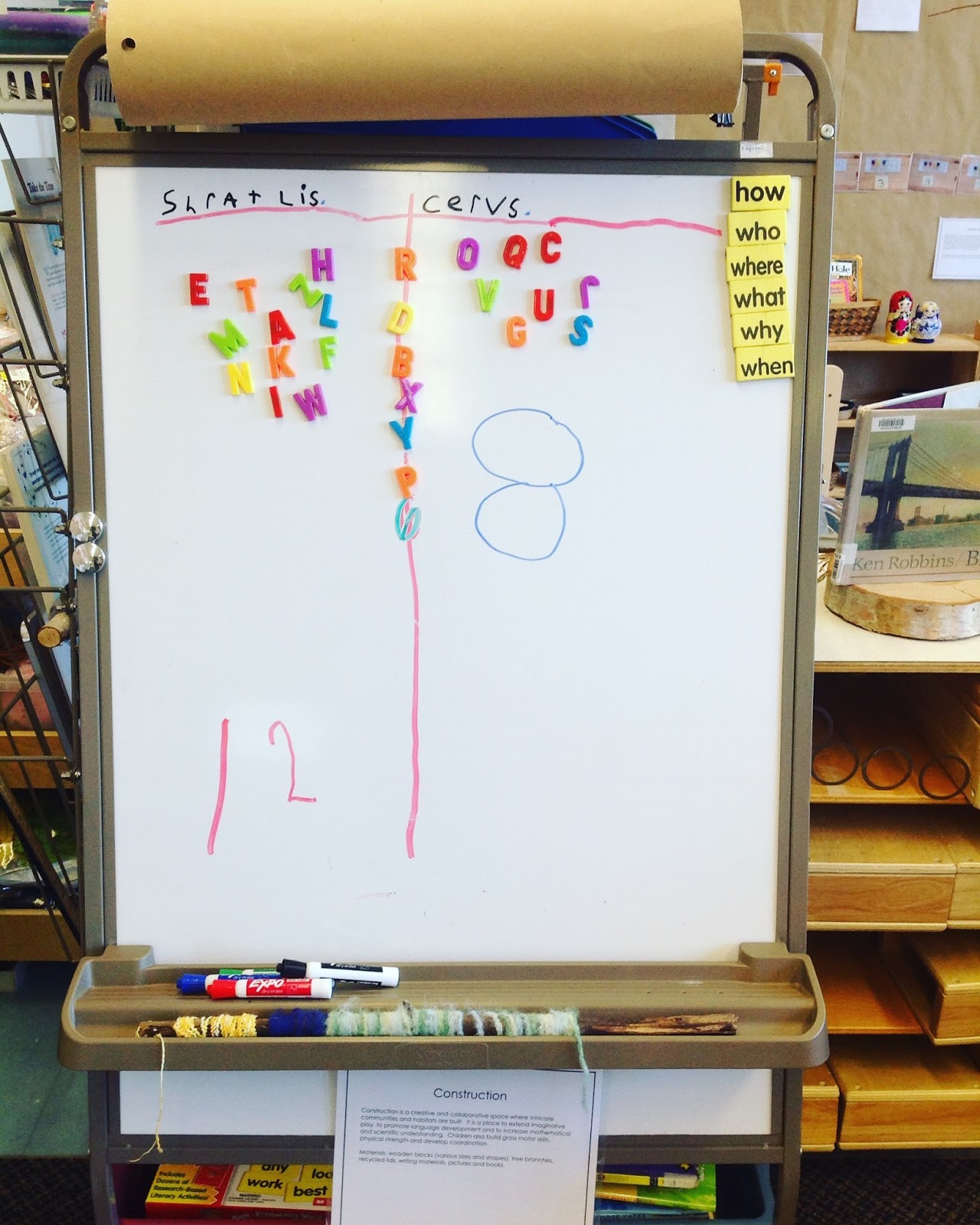
A few students decided to do a t-chart and sort the letters by straight lines and curved line. Take a look at what they started noticing while they did this. They got a bit confused with some but you should be able to figure out what they discovered!

Math concepts happen so often during play! Can you see all the math in their (N. M. and A. R.) creation? They shared it all with their peers!

J. K. and B. P. worked together on this detailed number story at the math carpet. Every piece placed had a purpose in their story! Here they are sharing their creation with classmates.

Creating surveys and asking classmates which pumpkin we should carve?

E. B. and J. K. creating a number story about different animals eating and playing with each other!


Extending our learning of patterns. They do not need to be straight! B. P. created this amazing growing design pattern! This has lead to a discussion about symmetry.


J. B. started using a My Story template to draw and "write" the story he created at the light table.


Z. G. and F. D. spend a few days counting all the seeds from the green pumpkin we cut open. They wanted to use the fastest method for counting. After some planning, they opted to use a few hundred charts and ten frame templates. They reported 406 seeds! A wonderful experience they shared with classmates!


But the seed experience wasn't over for Z. G. From the time we cut open our pumpkin he told me he had a plan to not only count all the seeds but to give everyone the same amount in little baggies to take home for crafts, planting or roasting. Here he is with A. J. helping him count ten seeds in every bag!

I have to admit, I wasn't sure how Z. G. was going to figure out how to give everyone the same number of seeds. But he asked me for 31 bags. He included myself and Mrs. Powell in his seed giving. He numbered the bags so he knew what bag number they were on and would know how many more to do. Ten seeds were then placed in every bag! Sure there are seeds left over but they did manage to give everyone the same number! Z. G. told me the leftover seeds were for the Art Studio so we can make art with them.  

K. C. surveying a classmate about our pumpkins. We often use surveys when we want to make decisions as a whole group. The students also like to vote. 

M. O. using a mirror to explore symmetry.

We are Mathematicians! 

I started printing pictures of learning moments. The students enjoy documenting their work and sharing it with the class. This particular documentation was placed on the math (We are Mathematicians) board.

E. B. and P. M. worked together to created this number story at the math carpet.

Our magnetic sight word board is carried around by students where they can easily see the words. Often students also take individual sight words with them and place them back once they are done using them. 


Log Book writing with one group of students.

Math instruction/games with another group of students.

Literacy instruction/games with a third group of students.
The groups all rotate to different activities depending on the day of the week.

M. N. drawing how her heart felt today. Knowing how children feel each day and listening to their explanations allowed me to support them better during the day and enabled them to reflect and recognize their emotions. 

S. F. made a card for C. P. but she didn't know how to write his name. He then got his name tag and wrote it down for her to see. Very resourceful!

A. F. created a survey about feelings and asked her peers how they felt today.

A few friends created a name graph at the math carpet. Based on the names they used, the found that M. N. as the longest name and Z. G. was the shortest! Here they are sharing their work with their classmates! Sharing is so important! It not only celebrates the work done by students, but also promotes oral communication, reading skills, critical thinking skills in terms of the questions and comments made by the audience, and supports the growth of new learning from others!

P. M. and G. S. creating self portraits of how they are feeling using open ended materials!


C. D., S. T., and B. P. drawing and writing about their story called Pony Lake at the construction area. 


A. F. and C. D. created a number line and growing pattern at the math carpet. They are documenting their work.


I enjoy when students bring things they find outside into the classroom. They usually have some great ideas as to what they want to do with them. These two girls brought in some leaves, grabbed a ruler and wanted to measure them so they can compare sizes.

It's important for children to challenge themselves, take pride in their work, and try to do their best. We co-created this display to know what best work entails. This applies to any area in the classroom!
The other chart on the right (How we write) demonstrates a few stages of writing. It's main objective is for students to think and see themselves as writers and to get reluctant "writers" to attempt to make a mark on paper. 

Painting with a friend has become quite a trend in our class. I am so happy that I was able to capture this tender moment between M. K. and E. C. as they explored using black and white paint together.

Look at the joy in their faces! I was walking by and i noticed how excited they they were because they created pink using red and white paint! Funny they weren't as interested in their painting as much but rather what colour the dirty water turned, which was pink! I would  have never known by looking at this picture what was making them so happy. Context is everything!


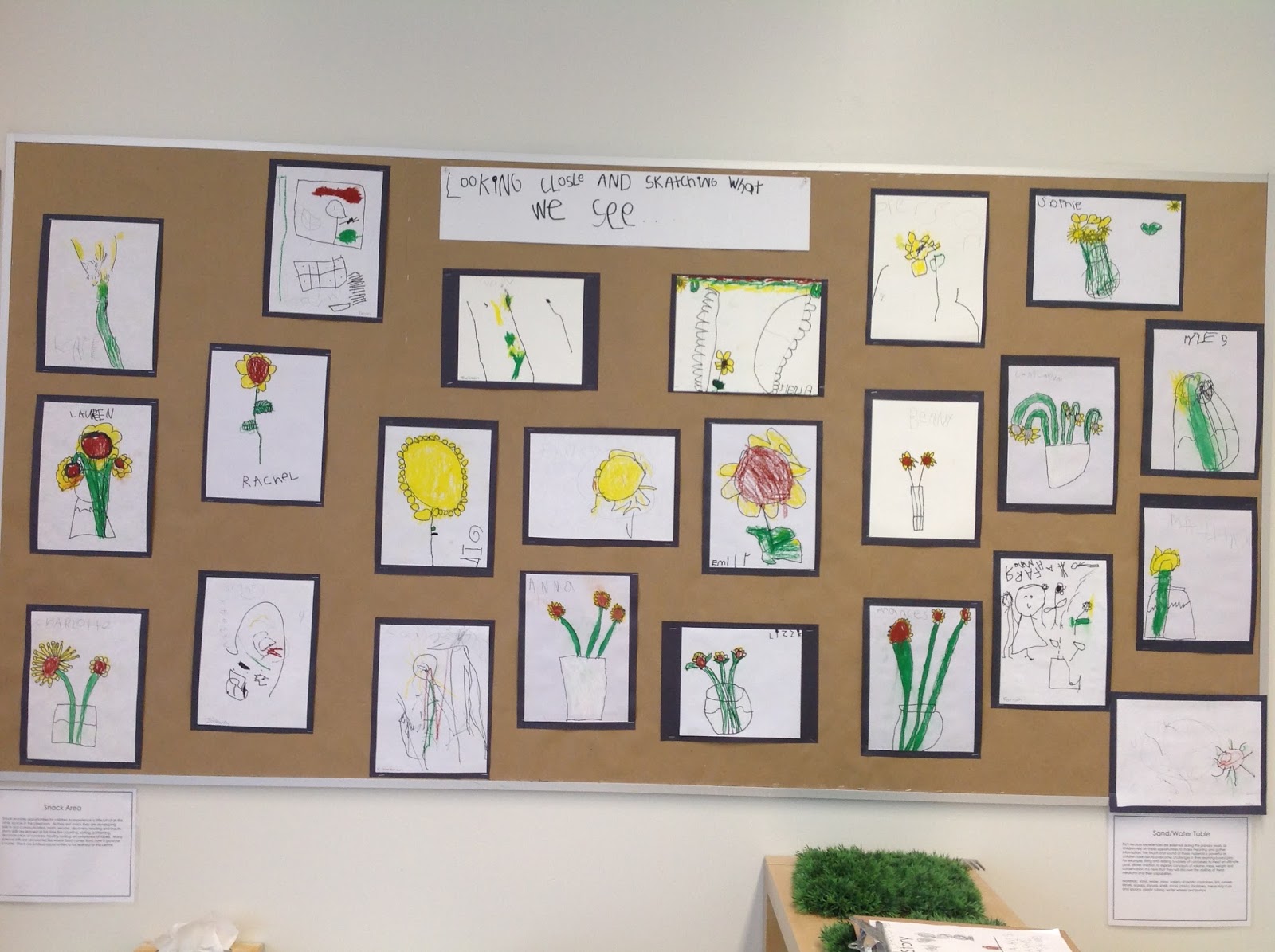
Our weekly sketching time with Mrs. Powell. During this time students get a quick lesson on different elements of design such as colour, line, shape, texture, form. Students are also introduced and shown how to use various art materials such as oil pastels, chalk pastels, charcoal, water colour paint, acrylic paint, clay, sharpies, etc. Students sketch still art, create self portraits, and learn about different art techniques. Sketching supports students with their fine motor, attention to detail by looking closely, and forming relationships with things they are creating. 


Saturday, 19 September 2015

A wonderful start to our journey of learning!

I would like to share some learning moments that have taken place over the the past couple of weeks. To say that I am amazed and proud of the children is an understatement. I'm not sure if any of you remember what it was like being a child of this age range and dealing with so many new things! Below are a few examples of the many new skills the children are learning and practicing:

  • learning to identify our belongings
  • changing our shoes (outdoor/indoor)
  • signing-in using the portraits we drew of ourselves so we know "How many children are here today?"
  • lining up and walking quietly in the school to other classes (e.g. gym, music, health, library)
  • being gentle and careful with the materials in our classroom and treating them with care while we play
  • following our co-created Classroom Agreement: sharing, being nice, being safe, being helpful, being respectful, and being patient
  • learning to take turns at different exploration areas in the classroom and at our self-regulated snack area
  • listening to our bodies when we are hungry or need to go to the bathroom, by taking the time to eat our snack or use the washroom
  • learning about feelings and how to identify how we feel
  • solving disagreements by talking things out with our peers or asking a teacher for help if upset/frustrated
  • cleaning up after ourselves if we want to explore another area
  • following instructions and transitions (e.g. outdoor exploration time, sharing time, lunch time, fire drill procedures)
  • being attentive, listening to stories, and responding to questions or comments
  • investigating different types of writing during exploration time (e.g. draw a picture, add words, My Story template, make a card, write a book etc.)
  • getting to know each other better (creating community and fostering relationships) by sharing our nature treasures and playing fun name games
  • making choices of where we want to play and doing our best work by thinking of an idea before creating


Some beautiful moments from our time together...

An SK friend supporting his new JK friend with using materials purposefully to create at the light table. 

Counting the numbers of cubes used in their creations! 

Building a castle together using natural materials and loose parts. 

C. D. used the jewels and tiles to create the letter C and D which are her initials! Why are they creating on mirrors? It allows objects to be viewed from another dimension.  

  Sorting the name tags into piles by the number of letters in each name.

 Co-creating our classroom agreement. The children suggested each item. They have the opportunity to sign the agreement showing that they are willing to follow their rules.

New friends creating a restaurant at the light table. 

A group of children decided to attach all the cubes together and see how long they could build it. Then they took the tape measure and stretched it out to try and find out how long it was. Placing real life materials in the classroom gives children the opportunity to explore, and be motivated to understand and learn their usage.  

Listening to their friends share their creation! At the end of the sharing questions and comments are asked. Each presenter takes turns picking from the audience!    

Creating a number line together! 

This melted my heart! One of our new JK friends was having a sad day missing his family. Our SK friend held his hand all day and decided to make this picture for him to feel better.

These two friends are quite interested in the rocks that one of their peers brought in as their nature treasure. I love the discussion they were having about what they noticed!

This new JK friend independently self selected the materials she wanted to use for her art creation. Taking direction very well, she used both hands to carry each container from the Art Studio shelf to her working area. As you can see in the photo, some materials are stored in glass jars. Children are very competent and capable. Respecting and learning how to treat materials is very important in creation relationships with the classroom environment.

I was wowed by the collaboration between these three friends! They came up with an idea and together build the city of Toronto! It includes a house with a family and kids, a garbage dump complete with a ramp and cylinders that take the garbage, and a tunnel leading to a restaurant that is on the island! Look at the detail in their work! The spool is the house with windows on the outside! They even have a boat with a driver to get to the restaurant! The restaurant has two chefs and the round lids are the tables! in this picture they are sharing their creation with their friends. Such rich oral language was used to tell the story!

The children worked hard drawing their little self portraits so they can fit on the ten frame grid. This will be a daily sign-in both in the morning and after lunch. It's a great authentic activity to get to know each other's names, as well as encompassing a whole lot of purposeful math!

The first sketching and oil pastel experience of the year! For some friends, this was their first exposure to using such art materials and sketching still-life. I am proud of their work, but more importantly, I am proud that they all attempted! 
*Not all pictures fit in the camera frame. All children chose to sketch.

These two friends are taking their time and placing jewels over the letters they chose to explore. 

Z. G. creating his birthday banner using a plastic sewing needle, string, and beads.

F. D. is creating her birthday banner! Children really seemed to enjoy this activity. It allowed them to slow down, focus, and use their fine motor skills! 

Many of our friends posed with their nature treasure! The stories about their treasures are amazing and allows us all to think and wonder about the different finds! 

Our wonder window allows children to use a binocular and observe the changes that may be happening in our school yard (e.g. the leaves changing colour, birds flying by, and weather changes)

Going to the Rock Garden for our first Outdoor Exploration! Children were fascinated with the sparkly rocks and the white bark on one of the trees! Other children enjoyed riding a "pony" on a big rock, planting a garden, and playing rock tag together!

I heard these two friends singing the alphabet song together as they supported each other with writing letters they knew! 


I also heard these three friends singing the alphabet song while following along in their Lego Alphabet book!

These two new friends decided to both work at the sand table. They thought of an idea and created this amazing castle! Crouching down with their My Story template, they are attempting to draw what they see!

After playing a name game with the name cards, these children decided to try and put the names from the "biggest" to the "smallest" name! Counting and comparing was required! Their reasoning with each other was quite interesting. It was nice to see such collaboration. 

These three friends decided to create a house with people sleeping on their beds on the top level! They are using a My Story template. We have been talking about what a story is and I hope that using this template will allow for more role playing and imagination.

Starting to explore patterns using open ended materials and the following guiding questions: What is a pattern? Where do we see patterns in real life? What different patterns can you make? This was M. K.'s first attempt with some support from myself! I should mention that provocations such as this, are open for selection by children. If I see that some children have yet to visit a provocation, I will invite them and engage with them in their exploration. If they do not want to participate, I may ask if they can come in the afternoon or the next day. I usually have a good response. We want to allow children as much choice as possible so that they maintain a positive outlook on learning without forcing when they are not ready to engage.

In My Heart is a wonderful story about feelings expressed by your heart. We hope children are able to self select a feeling rock based on how they feel and perhaps may even want to draw their feeling using the writing materials! Learning to be empathetic and treating others with kindness starts with learning about feelings and being able to recognize them.  

The birthday banners are complete! Children gained so many skills from this experience! Focusing, slowing down, using fine motor, and above all, unleashing their creativity!

I hope you are all proud of the children as much as Mrs. Powell and I are! 
We will continue to practice and extend our learning! 

I will leave you with a great poster about using specific questions/dialogue to encourage!