Sunday, 26 October 2014

Looking closely at lines

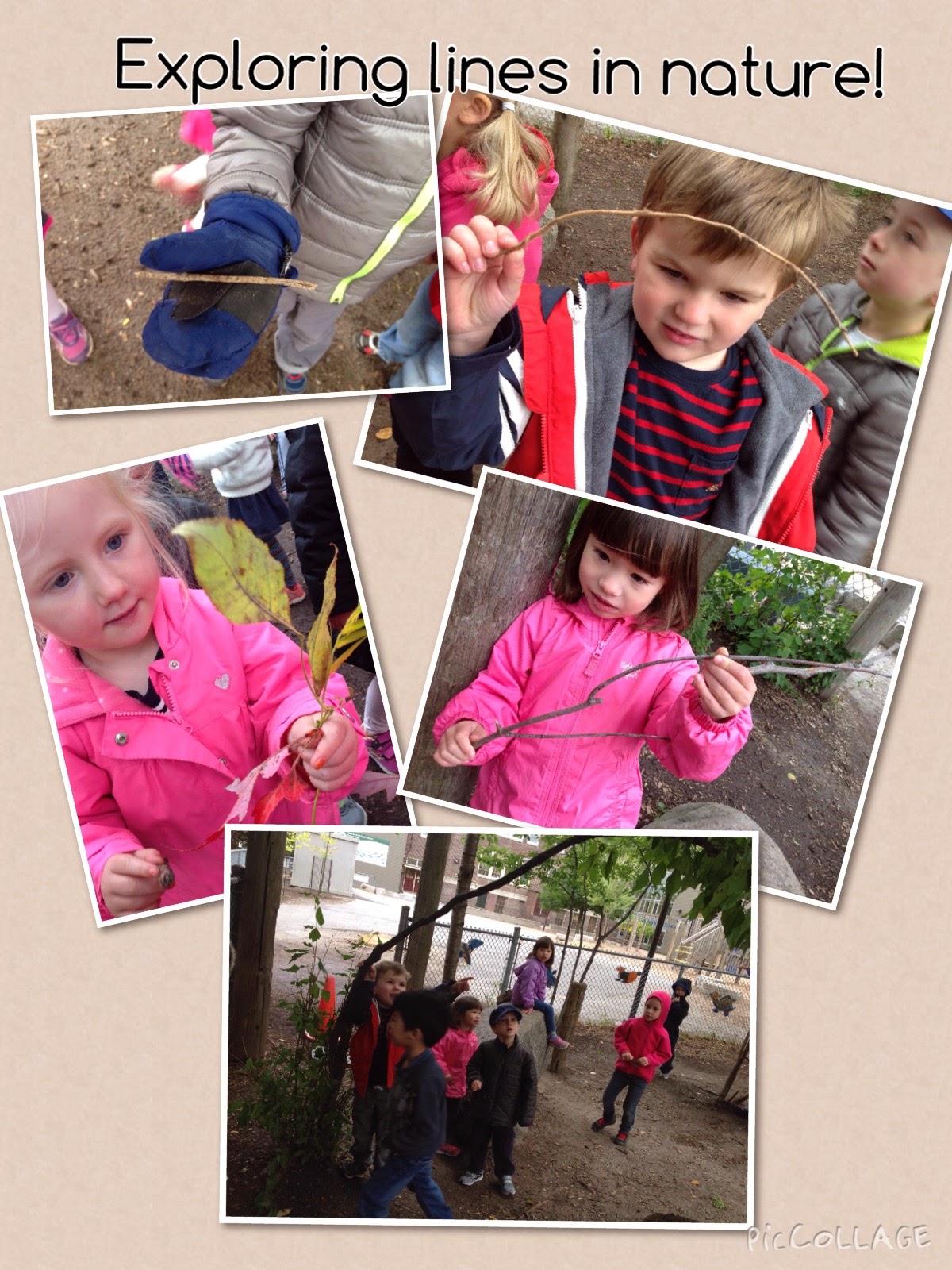
During the last few weeks, students have been pointing out lines they noticed on their clothing, and lines in objects found in our classroom and around the school yard. They were excited to show me their lines and identify them by name. One morning during outdoor play, S. C. proceeded to tell me more about lines:

"Lines are everywhere! Our bodies are lines! We can make lines with our feet and our hands! We can make lines out of wood chips!" 

It was interesting to see that looking closely at lines was starting to pick up momentum with the students again, so I asked them if they thought they could find more lines outside during our outdoor exploration? 

Take a look at their findings! 


Sharing the pen

Since the beginning of the school year, we have been exploring and investigating lines through various art forms: pencils, crayons, pastels, charcoal pencils, paint, plasticine, and wire. 

In adding another element, we decided to try creating a collaborative line art piece. A large piece of paper was placed in the center of the carpet with a pen. The students sat in a circle around the paper all asking each other what this was for, and what we were going to do?
The objective of the art activity was for each student to have a turn creating a desired line and passing the pen to their friend without removing the pen off the paper.

The students marveled at each other's lines and supported one another when passing their pen to their friend by reminding them to leave it touching the paper.
*Thank you for the wonderful activity Havergal College (Junior School)


Collaborative line art piece board display


Monday, 13 October 2014

Capable Learners: Reflecting on the Image of the Child

The ‘rich’ child is a co-constructor of knowledge, learning best by being engaged and by doing, by experimenting and researching with others - not by being told.

UNESCO Policy Brief on Early Childhood, N° 47, January – March 2010

Throughout the last few weeks, I have been amazed at the work and quality of learning that is happening in the classroom. It's encouraging to observe the critical thinking students demonstrate when they interact and manipulate open-ended materials that are purposefully placed to create an environment that supports self-selection, imagination, and creativity. The image we have of children is very important in terms of the capabilities we think they possess. Beautifully explained below are excerpts from Loris Malaguzzi, Found of the Reggio Emilia Approach:     

The environment you construct around you and the children also reflects this image you have about the child. There’s a difference between the environment that you are able to build based on a preconceived image of the child and the environment that you can build that is based on the child you see in front of you-the relationship you build with the child, the games you play. An environment that grows out of your relationship with the child is unique and fluid.

Malaguzzi, Loris. (1994). "Your Image of the Child: Where Teaching Begins". Exchange.

Loris Malaguzzi describes the rich as being 'rich in potential, strong, powerful, competent and, most of all, connected to adults and other children'. The ‘rich’ child is an active learner, ‘seeking the meaning of the world from birth, a co-creator of knowledge, identity, culture and values’; a citizen, the subject of rights not needs; and born with ‘a hundred languages’. The theory of the hundred languages of childhood refers ‘to the different ways children (human beings) represent, communicate and express their thinking in different media and symbolic systems’. These many possibilities range from mathematical and scientific languages to the many poetic or aesthetic languages expressed through, for example, the use of music, song, dance or photography.

UNESCO Policy Brief on Early Childhood, N° 47, January – March 2010

Believing that children have the ability to independently seek knowledge, and providing them with an environment that fosters exploration, investigation, and wonder, is evident in the capabilities that they possess and demonstrate. Below are a few images of the amazing learning from the past few weeks.


We need to produce situations in which children learn by themselves, in which children can take advantage of their own knowledge and resources autonomously, and in which we guarantee the intervention of the adult as little as possible. We don’t want to teach children something that they can learn by themselves. We don’t want to give them thoughts that they can come up with by themselves. What we want to do is activate within children the desire and will and great pleasure that comes from being the authors of their own learning.

Malaguzzi, Loris. (1994). "Your Image of the Child: Where Teaching Begins". Exchange.


Once teachers have prepared an environment rich in materials and possibilities, they observe and listen to the children in order to know how to proceed with their work. Teachers use the understanding they gain thereby to act as a resource for them. They ask questions and thus discover the children’s ideas, hypotheses, and theories. They see learning not as a linear process but as a spiral progression and consider themselves to be partners in the process of learning.

Gandini, Lella, "Values and Principles of the Reggio Emilia Approach," in Insights and Inspirations from Reggio Emilia: Stories of Teachers and Children from North America. Ed. Lella Gandini, Susan Etheridge, Lynn Hill. Davis Publications, Worcester, MA. 2003


All children have preparedness, potential, curiosity; they have interest in relationship, in constructing their own learning, and in negotiating with everything the environment brings to them. Children should be considered as active citizens with rights, as contributing members, with their families, of their local community.

Gandini, Lella, "Values and Principles of the Reggio Emilia Approach," in Insights and Inspirations from Reggio Emilia: Stories of Teachers and Children from North America. Ed. Lella Gandini, Susan Etheridge, Lynn Hill. Davis Publications, Worcester, MA. 2003


Sunday, 28 September 2014

How do birds make nests?

Since we are investigating how bats and birds are different, the students thought it would be best if we had two sets of wonder charts at the Discovery Area. One for bat wonders, and one for bird wonders.

As so often happens with inquiry in an emergent curriculum environment, the presence of one spark can ignite the interest of many! 

One afternoon, O. M. brought me a stick he found outside at lunch and told me he wanted to use it to create a bird nest. I asked him how he knew birds used sticks to make nests? He responded by telling me he saw sticks in the nests we had at the Discovery Area, and in some of the classroom books abut birds.

Seeing that some students were already creating nests using plasticine, and W. E. and E. E. posted the wonder question, "How do birds make their nests?", I asked the class what they thought about O. M.'s idea of collecting materials to try and make nests like birds? The students loved the idea and so began our investigation. 

I brought in some wonderful books about nests and placed them at the Discovery Area. 


It wasn't long before pages were filled with post-it-notes that students felt were important in helping us learn about the types of materials birds used to create their nests. 

We ventured outside! 


"We need string, sticks, feathers, leaves, all that stuff for the birds nest (looking at the book)!" J. S.

"We need to find moss." W. E.

"I found bark!" O. M.

"I found string for the birds to make a nest!" L. S.

"I found something for the birds, it is like string!" A. F.

"I think I found some seeds. They were on top of the leaves and I think birds can find them to build with." O. S.

"I found string! Birds use string to make nests." M. O.

Back in the classroom, we decided to sort the material.


"I found lots of little tiny sticks and rocks. I think birds use them to make their nests." J. K.

"I gathered lots of sticks and put them in the bucket." R. S.

"I got some string to make a nest." L. S.

"I found rocks, leaves, and bark so the nest is warm." O. M.

"I saw some sticks in the book, then I went and grabbed them." J. S.

"I found mud, and I found leaves and bark so the nest stays in the tree and doesn't fall." A. F.

"I found one tin foil and I found lots of sticks. I'll try to make a nest." M. S.

"I picked a stick cause I want to make a nest." B. P.

The next day, I placed the provocation out for students to explore and investigate nest making with the materials they collected. 


To further support their learning, I showed them parts of a video I found of a Robin building her nest. 


It was interesting to listen to conversations and observe students as they created their nests.

They experimented with the best way to make their nest like a bowl. Some made a flat round shape and lifted the sides, others rolled and made a sphere, then used their thumbs to make the center hollow. When they added different materials, they used some of the books to help them figure out which nest they wanted to create.

"My nest is the shape of a circle." H. S.

"The birds spin around in the nest and makes the shape of a circle!" W. E.

"The nest is made of feathers." C. C.

"My nest is shaped like an egg, an oval." O. S.