A partial view of Our Nature Treasure Stories board display
When I contacted the families of my students this past summer I included a nature treasure letter detailing the objective of the project and stressed the importance of having the students select and connect with their chosen nature treasure. This was evident in their excitement to share their stories with me during the first week of school. But it was A. R.'s sharing moment that not only took us on an inquiry journey, but also made me reflect on the letter I wrote to families and what I neglected to consider.
A. R. brought in a snail. In my letter I gave examples of natural artifacts that were non-living in hopes of supporting families in finding some of these treasures with their children. During the first week of school, children placed their nature treasures at our Discovery Area where everyone could observe and explore each others artifacts. Sadly I was not aware that A. R. brought in a snail and unfortunately it died. When I spoke to A. R.'s mom, she told me that she was so attached to the snail that even when she told her daughter that is was a living creature and our treasures had to be non-living, she still wanted to bring it in.

A. R. holding the label of her nature treasure, a snail.
I am grateful that this situation presented itself. When I spoke to A. R.'s mom she advised me to use this as a teaching moment which I did. I asked A. R. if she still wanted to share her nature treasure story even though her snail had passed away. She was very brave and agreed.
"I found my snail beside my home outside in my backyard, it was sticking to something. I picked it up and showed I. R. (sister). I put it in my snail house. But my snail died. I think it's because it didn't have any food or water?" A. R.
"They don't need to eat because they don't have a mouth." G. S.
"I don't think plants and trees are alive because it doesn't have hair and eyes and no legs. But a magic tree can be alive." A. R.
"Trees are actually alive even though they don't have eyes, nose, hair, and legs." M. S.
"Plants and trees are alive, they just need food and water." Z. G.
"They need the sun to shine for food." L. B.
"They need seeds. They grow and plants and trees eat them." S. F.
"Plants and trees have roots. They need roots to get the water from the rain. They suck it up." C. C.
"We don't need to look after the snail shell because there is no mouth and nothing inside." S. F.
"Snails have a mouth and eyes. The eyes are on the antennas so it's alive." M. S.
"My dad has no hair and he's alive!" M. O.
"Every time I go to the cottage and there's water there I see thousands of alive snails!" F. D.
It was very interesting to listen to the reasoning that the children gave for identifying something as living. I was starting to wonder if this was going to be a topic that arose during the sharing of other nature treasures...
M. N. shared her rock that she got from her grandpa's house. It has a hole in the middle. During her sharing I asked her if she thought her rock was alive...
"It's living because it stays at my home. I keep it in my drawer. I love it." M. N.
Z. G. brought in some animals bones from the nature museum in Ottawa.
"Bones hold your skins, like your skin stand up not shrink down. It's not living because it's just bones, it needs skin to live." Z. G.
"Snails don't have skin and they're alive." A. R.
"But they have slime." Z. G.
L. S. found a crystal at her cottage. "I was swimming and I saw a crystal on the beach. It's not living because I don't see eyes." L. S.
"Trees are alive and they don't have eyes." F. D.
"It's not living because it's not in the water." R. S.
"Grass is alive and it doesn't have eyes!" P. M.
"Crystals aren't alive because my dad told me, it doesn't have ears." M. S.
"You don't need a part of a body to live, like grass is alive but not part of a body. I know grass grows." Z. G.
"A worm is alive! I saw one yesterday!" C. T.
C. P. found a stick while walking to school with his sister and mommy. "It's a tree stick. I liked it because it's smooth and you could play with it and you could build a house with sticks." C. P.
"I don't think it' alive because it doesn't have eyes, nose, mouth, and legs." C. P.
"Not living, it falls off." C. T.
"Stuff doesn't have to have what humans do, like arms, hands, feet, eyes. Like grass, it's alive." P. M.
"It's not living because it doesn't move and it doesn't make a habitat." F. D.
"Nature doesn't need to be alive or not alive, like grass, it doesn't have eyes, hand, and feet." L. B.
"A flower is alive." C. D.
The children's reasoning and theories were fascinating but I also realised just how complex this topic was for them. Without reading them facts and telling them answers, my goal was to figure out a way to make their learning more hands on involving the use of their senses. I also wanted to support them in exploring and investigating their theories.
I decided to have students try and classify their nature treasures into three categories: Non-Living, Living, and Don't Know. During Exploration Time, I invited the children to place their nature treasure under one of the categories that they thought it belonged.


After all the children placed their nature treasure in the category of choice, we gathered together to discuss some things we noticed.
"The rock needs to swim, it needs to be at the beach with water." M. N. placed her rock in the living category.
"My collection needs water because I found it at the beach." S. F. placed her shells in the don't know category.
"My butterfly is non-living because the wings are not on the butterfly." C. D.
"My mosquito is not living because it's lying down and it needs blood and water to come alive." B. P.
"My mosquito is not alive because when I picked it up it started breaking." P. M.
"The bark is not alive because you pulled it off the tree." R. S.
"You need food to be alive." C. P.
"They are not alive because they have no legs." M. K. placed his acorns in the non-living category.
"I don't think my crystal is living because it's not moving." L. S.
"You should put it in the no section because the creature's not inside." K. C. telling R. S. which category she should place her clam.
"If the animals in the shell it's alive if not then it is not alive." M. S.
"My snail was living because he was sticking out of the shell, he was eating and moving." A. R.
"I put my rock with crystals in the don't know pile." D. F.
F. W. placed her bark in the don't know category.
"It doesn't have food and water anymore because it was on the ground." F. D. speaking about F. W.'s bark.
"Trees actually drinks water when it drinks it grows every second." M. O.
"Trees are alive because the roots give it water." P. M.
"It's still alive if it gets food and water even without a body or legs." F. D.
"Worms have slime and it's alive." M. S.
"Living things need to have food, water, and move." P. M.
"Trees and grass are alive but they don't move?" F. D.
Listening to the children's reasoning and theories was very interesting. It was not important whether or not they were correct, what was amazing was the critical thinking skills they were using and gaining in rationalizing their ideas and thoughts as well as listening to their peers and agreeing or disagreeing with their ideas. Listening to the children's conversations also allowed me to get a sense of the things they understood and the many questions they had. As is often the case with inquiries, the objective is not so much to seek out the correct answers but rather to follow the children's questions and provide them with extensions and challenges through experiments and investigations that allow them to come to their own conclusions where they can explain their thinking.
I decided to consolidate some of the information that was said by the children based on the following two questions:
1. What do living things need?
2. How do we know it's living?
"If it doesn't have water and food it's not living." C. C.
"To be alive needs water and food." L. S.
"I has to move." A. R.
"It needs to grow and move." P. M.
"It needs to move and grow and has to stay like it was, doesn't change." M. O.
"Living things need food, water, and sun, and they have to grow so they can get bigger." R. S.

As the children kept sharing their nature stories with their classmates, new information presented itself which continued to keep them interested and help move their thinking along.
"I found this on my front porch with my dad. He was holing it. It's a mosquito. I found it in the daytime. He was alive when I found it but I put it in a bag and it died because it didn't have holes in it and my bug needs blood! That's food you know!" B. P.
B. P.'s nature sharing sparked a discussion about the need for air.

B. P. holding his nature treasure, a dead mosquito.
"I have a centipede on my back porch in a jar with no holes and it's still alive! So I am comparing it to B. P.'s and I don't understand? I am planning on bringing it in." C. C.
"Everything doesn't have to have air like plants, trees, and flowers." F. D.
"Yes they do get air, leaves get their air from the top." Z. G.
"Plants have air because they are outside." L. B.
"For something to live it needs oxygen. It's something that helps you breath." M. O.


C. C. brought in her centipede and we observed it for a few days. The students noticed it moved but were quite confused as to why it continued to live without a food source or any water or air.
"I think that the plastic lid, that the air can get through the crack of the lid." P. M.
"Maybe centipedes don't eat anything?" B. P.
"I think it needs water, and food, and air to stay alive." K. C.
"He is lying down cause he is tired." A. R.
"I think they eat leaves." M. S.
"They eat leaves because I saw one on a leaf." M. O.
"I see them in my backyard and sometimes they eat leaves and bugs." J. B.
"Oxygen is actually air." B. P.
"A ambulance has oxygen. I saw a guy getting oxygen through a mask in a ambulance." J. B.
"Oxygen can be anywhere!" K. C.
"If it dies I know because the other one is curled up and moldy and not moving." C. C. referring to the other centipede she had.
Feeling sorry for the lonely centipede alone in the empty jar, we decided to research what a centipede's habitat includes and what they eat. We then provided him with a nice little home and even placed holes in the lid of the jar.
"I think that the plastic lid, that the air can get through the crack of the lid." P. M.
"Maybe centipedes don't eat anything?" B. P.
"I think it needs water, and food, and air to stay alive." K. C.
"He is lying down cause he is tired." A. R.
"I think they eat leaves." M. S.
"They eat leaves because I saw one on a leaf." M. O.
"I see them in my backyard and sometimes they eat leaves and bugs." J. B.
"Oxygen is actually air." B. P.
"A ambulance has oxygen. I saw a guy getting oxygen through a mask in a ambulance." J. B.
"Oxygen can be anywhere!" K. C.
"If it dies I know because the other one is curled up and moldy and not moving." C. C. referring to the other centipede she had.
Feeling sorry for the lonely centipede alone in the empty jar, we decided to research what a centipede's habitat includes and what they eat. We then provided him with a nice little home and even placed holes in the lid of the jar.
An inquiry can be an amazing learning journey but it can be very challenging when trying to offer purposeful experiences to support and challenge children's thinking. After such wonderful discussions I must admit I was stuck. I wasn't sure which direction to take this inquiry.
Once a week we offer a sketching session for the children. Around this time my teaching partner brought in three very different looking pumpkins for the children to sketch. As soon as they saw them they immediately started looking, touching, and smelling them. I started wondering if this experience may help us with our current inquiry?


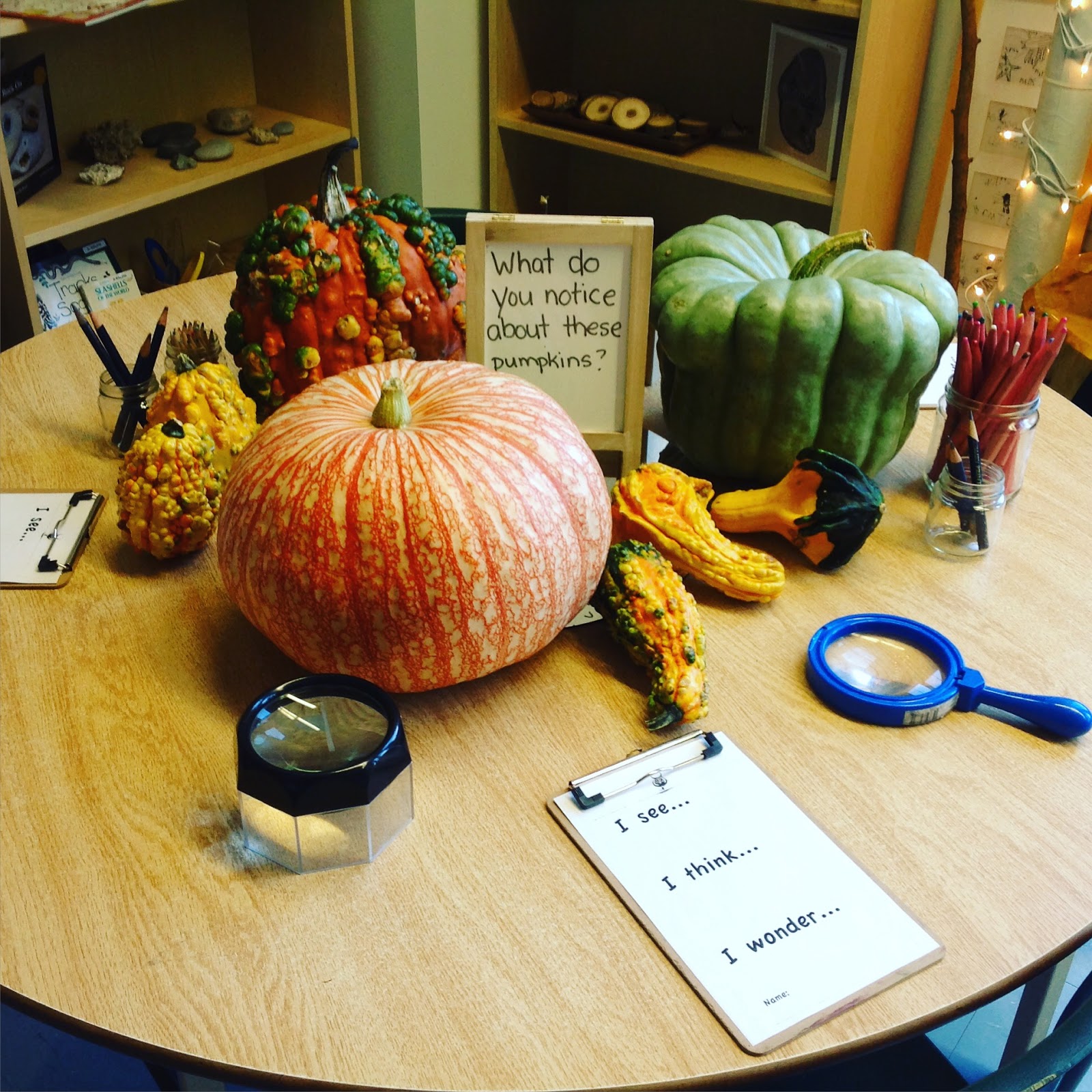
"Are our pumpkins alive?" Z. G.
This became our main wonder question. Based on the class survey, ten students thought they were alive, five thought they were not alive, and thirteen didn't know!
This experience allowed children to observe the pumpkins using their senses and account for any changes they noticed happening.
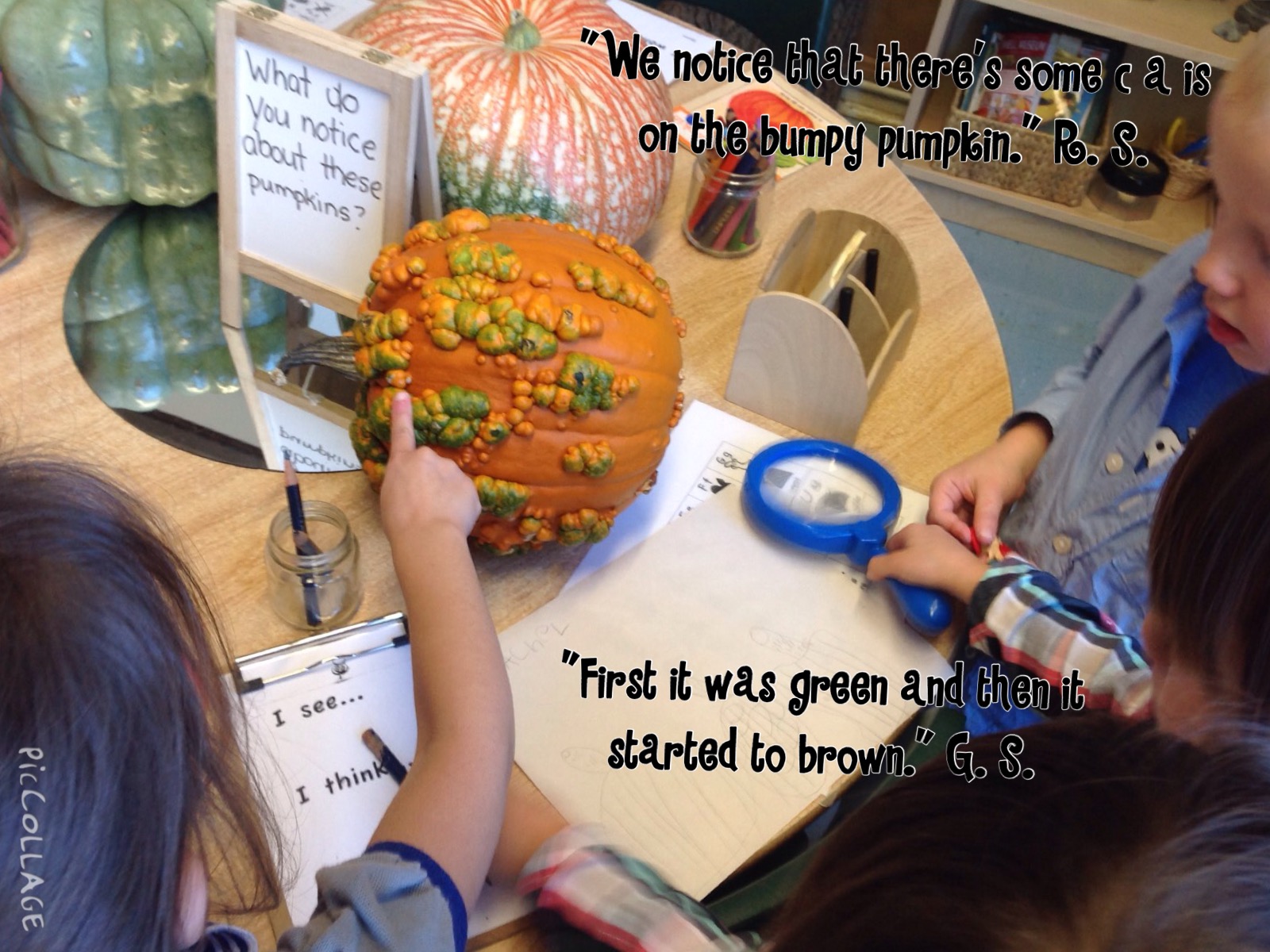


In trying to figure out our wonder question, "Are our pumpkins alive?", I asked the children how we could find out?
I was so proud of them when they mentioned to measure them with a ruler, weigh them, and see if they would get bigger and grow.
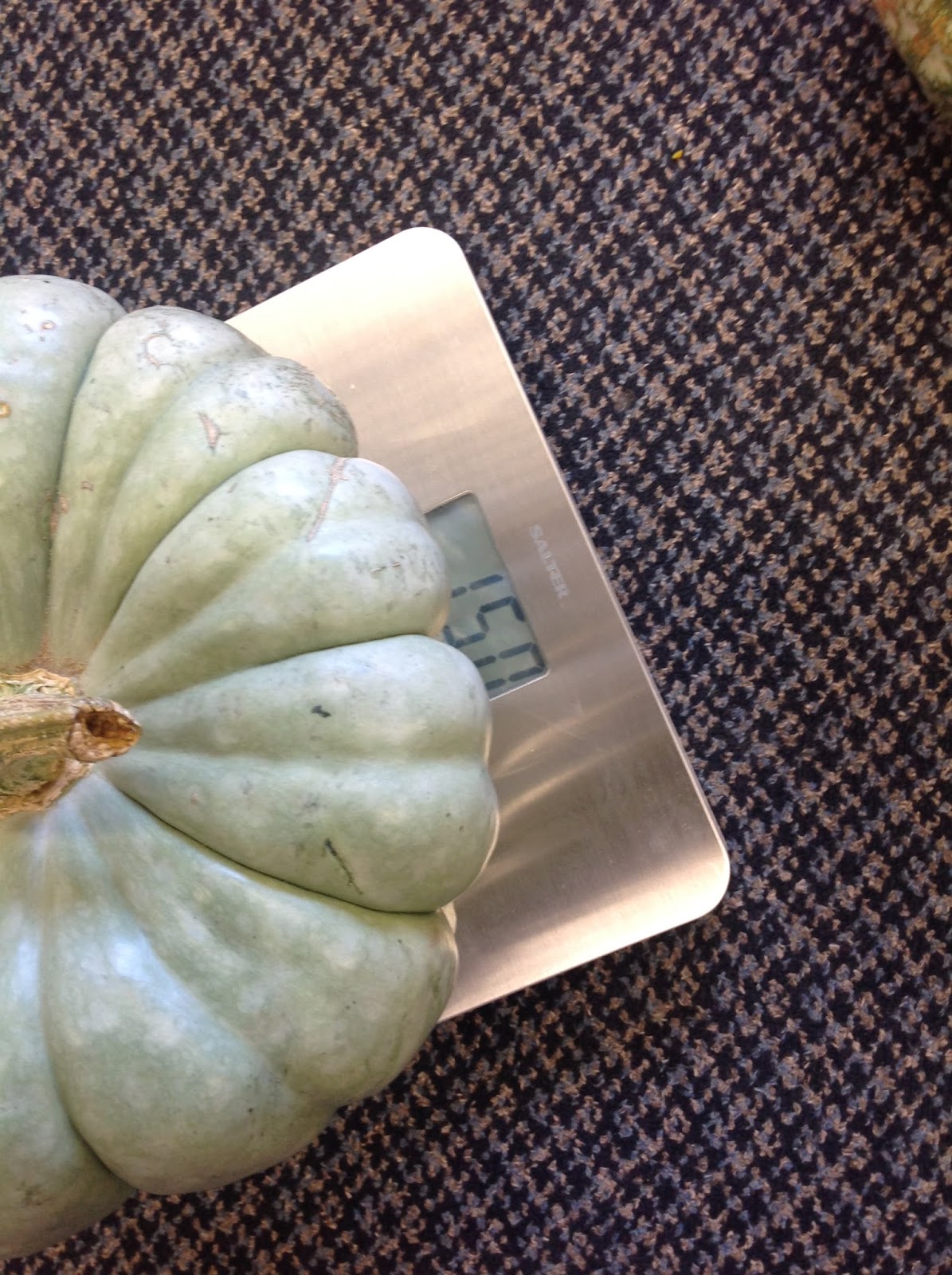


We continued to weight and measure our pumpkins for a couple of weeks. The children didn't notice any changes in the pumpkins. The numbers were the same and they were not getting heavier or bigger around.
As a way to further support learning about growth, I read the book "Do you know which ones will grow?" A great book comparing living things and non-living things.

Responses by the children after reading the book:
Can a sweater grow?
"No because it's made by someone." L. B.
Can a car grow?
"A car needs gas to grow. Sometimes they are alive but not if they are broken." J. B.
"A car is not alive because it drinks gas. It goes into a hole on the side and into the engine." C. P.
"One time my mommy lost a piece of a light on her car but it's still alive because it was still moving." C. C.
"People are made by people and they are alive. Living makes living." Z. G.
"Did you know there are living and not living things in the book?" K. C.
It was interesting to note what some children's reasoning was for something to be classified as living and non-living.
The children continued to observe the pumpkins and recorded the changes they noticed.


One day a group came to me and were excited to show me what they noticed in this book!


At our next focus time, the group shared the new information that they found in the book with their peers. I also decided to read the book to the class for added information.
One page in the book discussed pumpkins being gone in November. I decided to ask the children why they thought this was the case?
"Because they start to rot." L. B.
"Because they're dying." M. N.
"They're getting smelly." S. F.
"Because it's fall." S. T.
"Because it's getting colder." F. D.
"They can't grow. They need hot air." Z. G.
"Actually when it gets hotter they pumpkins start to rot. My mom told me." C. C.
"How do pumpkins rot?" M. K.
"Because they don't grow in November. I saw on not grow." J. B.
"The vine is not attached to the pumpkin anymore and the vine is attached to the roots and the roots give the pumpkins the food and water." M. O.
"But the book said the pumpkins will die on the vine!" P. M.
"My pumpkins are not dying and they're not on a vine, they are on my porch." C. C.
It was time to investigate the inside of the pumpkins. Perfect timing as it was our Halloween activity day in our class. Some children surveyed their peers and by popular vote, the green pumpkin was the one of choice to be cut!


"It smells like cucumber!" G. S.
"I saw a movie about Sid the science kid, I learned that the pumpkins get rotten and the seeds come out and the goo turns all brown!" L. S.
"It smells like squished tomatoes!" E. B.
What can we do with the seeds? Mrs. Ralph
"Let's put them in here and count them by tens!" Z. G.
"Let's plant them!" A. J.
"I saw a movie about Sid the science kid, I learned that the pumpkins get rotten and the seeds come out and the goo turns all brown!" L. S.
"It smells like squished tomatoes!" E. B.
What can we do with the seeds? Mrs. Ralph
"Let's put them in here and count them by tens!" Z. G.
"Let's plant them!" A. J.
Why do you want to plant them? Mrs. Ralph
"So we know if they're alive!" Z. G.
How will we know if they're alive? Mrs. Ralph
"If they grow!" M. O.


The other half of the pumpkin was left in a container.

Observations made by the children:
"I notice that there is water inside the pumpkin." J. K.
"There are little things flying around the pumpkins." C.C.
"The pumpkin looks like it is turning orange." J. B.
"I see little white dots." B. P.
"It looks like it's mix colours." C. T.
"There is so much black stuff in the pumpkin." F. D.
"The pumpkin is rotting and turning black. It's dying!" M. K.
"Wow! There is liquid inside and it smells bad! Yuck!" P. M.
"Why is it juicy?" E. B.


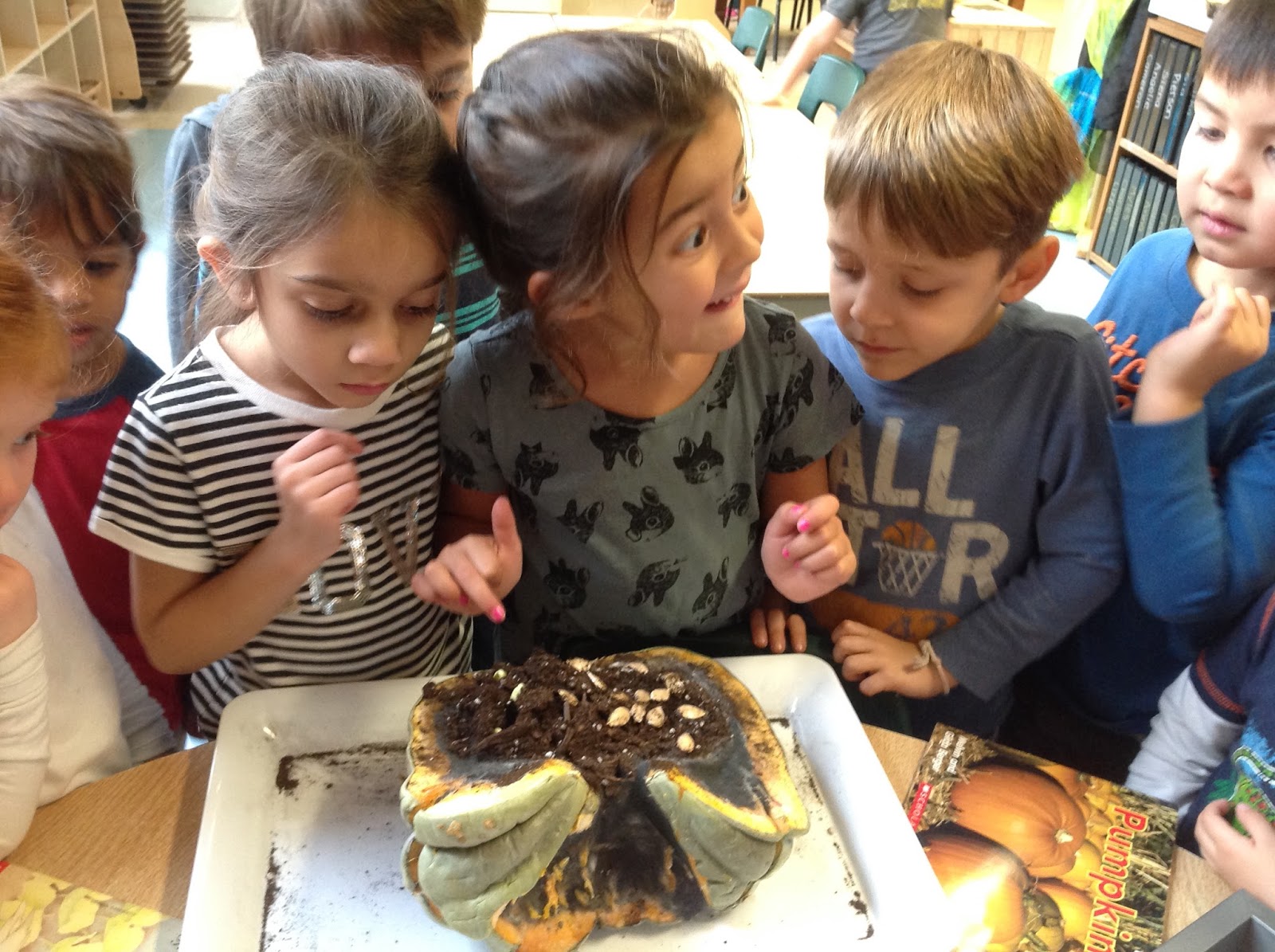
"There are little green things coming out of the pumpkin!" S. T.
"This sprout is growing even more and these two part are sticking out! Two have sprouted! I wonder why they are flat on the end?" P. M.
"The leaves are slowly coming out of the ground." Z. G.
"Why is it growing like a bridge?" C. D.
"The green pumpkin has sprouts coming out of it!" J. B.
"Seeds are alive they are starting to grow. We gave them soil, water, and air." C. P.


"Pumpkins do not live forever because it's getting darker." S. T.
"Bugs love stinky stuff." M. O.
"The bugs are not around the one with the soil because the soil is covering up the smell." Z. G.
"Decomposing happens after rotting." M. O.
"Decomposing means it's starting to rot." P. M.
"There is a lot of liquid in the pumpkin." C. P.

One half of our pumpkin was so rotten and moldy that we started having a lot of flies in our room. The smell was horrible and it was starting to fill the container with liquid from it decomposing. We were all plugging out noses!
What should we do with this half of the pumpkin?
"We can compost it, put it in the ground and wait, the worms will eat it and will turn it into soil!" Z. G. (some of the students from last year clearly remember the experiment we did where we buried our compost snacks to see what would happen!)
"We can compost the one with the hole in the container and watch the one with the soil and see if it dies before the sprouts grow and turn into a flower?" P. M.
"We can just wait to see what happens?" K. C.


In the spring we agreed to dig up our pumpkin and see if anything happened to it?

Students started bringing in the crab apples from our school yard. I asked them why they wanted to bring them into our classroom. They mentioned that they wanted to wait and see what would happen to them over time.
P. M. was excited to see if the pumpkin sprouts would grow any yellow flowers? We learned from one of our books that pumpkin plants grow yellow flowers!


"The pumpkin is squishy and when I squish it water squirts out.There is something in the pumpkin that makes it grow fast. It's food, it doesn't need to make it's food!" Z. G.
I reminded the children that they wanted to plant the seeds to see if they would grow and that would tell them they were alive. So I asked them, "Are the seeds alive?"
"Yes because they growed!" G. S.
"Yes because they had water, and food, and air!" J. K., L. B., and F. D.
Why did the seeds that Z. G. counted that are in the bowl not grow?
"Because we didn't give them food or water, we only gave them air." K. C.
"There wasn't any soil in the bowl." L. B.


Seeing that this part of the pumpkin was also starting to decompose pretty bad I asked the children if they could help me transplant our sprouts into a new container. This lead to a wonderful sensory exploration of the decomposing pumpkin!
"The pumpkin is more squishy and it smells bad like a rotten banana!" L. B.
"It's gooey and soft!" C. D.
"It's getting all mushy because it's rotten. The juice is coming out!" A. F.
"The pumpkin is smushy and stinky." A. J.
"The pumpkin turned mushy and it is flat and smells like rotten apples. It's decomposing because it's winter and getting cold." M. S.
"I think the pumpkin is all mushy because on the weekend it took so long for the pumpkin to grow the sprouts!" S. T.


We had a few gourds in the classroom as well. They were of no interest to the children until we cut open the green pumpkin and observed it decompose. One day L. B. asked if we could cut a few of the gourds open as one felt light and changed colour from orange to brown. When she shook it she told me she heard seeds inside!

The gourds were at different stages of decomposition. Some were hollow and the seeds poured out of them. Others were still a bit moist and the seeds were stuck inside.


Some children decided to plant the different gourd seeds to see what would happen.


This "bumpy" pumpkin we left whole to see what would happen to it. Would it decompose the same way as the green pumpkin we cut open?

Our growing documentation display about our pumpkins and the changes of decomposition and growth noticed by the children.
I wonder what new wonder questions the children will have? What direction will the growing of the seeds lead us on? Perhaps the crab apples and the gourds will have us explore stages of decomposition more closely? Plants are considered living things but what makes them different from animals? The inquiry journey is always exciting and one cannot know for certain what direction(s) it may lead to as it's strictly based on the curiosity and fascination of the children! Stay tuned...