Sunday, 1 March 2015

Freezing and Melting: Exploring Ice Part 3

The students continue to marvel and wonder about ice. This is not only evident at school, but also at home. It's exciting to have students bring in ice experiments that they did at home, and want to share their findings with the class. The types of experiments shared have sparked many class wonders and have motivated students to want to try certain experiments themselves.

The pictures below showcase students exploring the shapes, weight, and melting rate of the green and regular ice brought by Z. G. from home. 


In our last post, the students were debating whether ice gets bigger or grows, or whether it gets smaller when it freezes.

O. S. was very interested to find out and did an experiment at home with her family. The next day she brought in her findings and wrote the steps to her experiment to share with the class.


Before sharing her findings with the class, O. S. asked the class what they thought would happen?

"I think it will freeze and grow higher than the line." D. A.

"It will stay the same, because if you freeze it you can't get more." Z. G.

"Hmmmm...the same." S. T.

"I think it will stay the same." B. K.

"I think if we put it in the freezer it will be exactly the same". M. S.

"I think it will stay at 200, because I think ice doesn't grow." J. K.

"I think it will be the same, I don't think ice can grow." A. T.

"I think it's going to grow because when I did my ice it growed. Then I put it up to here (shows with finger), and then it went up to her (shows with hand) where it freezed." C. D.

Before showing O. S.'s experiment, I asked the students if they wanted to try doing the experiment as well to see if we get the same result. The next day, C. C. also tried the experiment at home. 


I then showed the kids all the experiments and asked them what they noticed, thought, and wondered.

"It grows bigger!" Z. G.

"It grew bigger because the lines are lower than before." O. S.

"O. S.'s is at 300! It grew bigger because it used to be at 200." J. K.

"It got bigger so that's why the jar broke!" O. S.

"Why does ice stay the same shape a what you put it in?" F. D.

"Why does ice grow?" K. W.

"Maybe because it depends on the temperature." S. C.

"Because when ice, when you just put ice in the freezer and when it gets colder it starts to grow." C. C.

"I agree with S. C." J. K.

"I think because the water is moving up and when it gets more freezing it keeps gong up." W. E.

"I agree with S. C." E. E.

"What do you notice about the green ice C. C. made? Mrs. Ralph

"Maybe the food colouring stops it from growing and the one without food colouring grew." O. S.

"It gets bigger because ice gets stronger and it depends how long you wait. It gets bigger because it grows, it broke a piece off the glass." H. S.

Some students brought in experiments from home that contained objects in the ice!


H. S. brought in two pieces of ice. Each ice contained a dinosaur.

"The dinosaur in the coloured ice didn't grow because I put it in the freezer. This one did grow because, well, first we put water, then we put the dinosaur and then it was growing a little bit and then we froze it." H. S.

"Why did you get the idea to put a dinosaur in it?" O. S.

"Because I wanted to see what would happen to the dinosaur if it will grow or not grow. I wasn't that sure but once it growed in water without freezing it, but I wanted to know if it will work with ice." H. S.

"Why did you want to make three colours of your ice?" A. T.

"Because I wanted to see if it was mixing?" H. S.


K. E. also did an experiment at home that he brought in to share with the class.

"First I got a bowl and then put the dino in and then put water in it and put it in the freezer. Before I went to sleep I add two drops of pink and two things of blue and it is blue! I put one dino in the experiment." K. E.

"What are the lines." Mrs. Ralph

"It is the water and when he added the colours in the freezer some made the lines because it was cold." P. I.

All the experiments done by students were always placed at the ice area for further hands on exploration by students. I wondered what aspects they were going to explore from H. S. and K. E.'s experiments. As I observed them interact with the ice, I noticed how fascinated they were with the way the ice was melting. They were trying different things to make the melting rate speed up so they could get to the dinosaurs! 

P. I. didn't bring in the experiment she did with her family but she wanted to share what she noticed while playing in the forest near her house!

"Me and my mom, and my brother, he put ice in water outside and then he put some snow on the ice, and then the ice it floated up on top of the water! It was in my backyard, there was some water near the forest. I made the ice at my house in the freezer. I noticed that when the ice went up the water was shrinking down!" P. I. 

I decided to ask the class their thoughts about what P. I. discovered. 

"Can ice float?" Mrs. Ralph

No one seemed to know for sure, and no suggestions were made by the students. I was a bit sad as this would make for a wonderful exploration, but I decided to leave the discussion and not push this idea from me. I was hoping the right opportunity would present itself and spark interests authentically.

K. W. also froze some ice at home and decided to place some items inside!

"Yesterday I made ice and I got water and I putted water in a bag and then I got the idea to put sea glass in it and I put one yellow rock, and then I putted it in the freezer, and then when I woke up the next morning it was a big chunk!" K. W.

"Why did you want to put sea glass in water and freeze it?" Mrs. Ralph

"I never done it before and I wanted to try it. I thinked it would freeze against the ice." K. W.

During free exploration, I noticed R. S. and L. S. trying something interesting with K. W.'s ice!


I quickly called over the other students so they could see what R. S. and L. S. found out!

"It's floating!" Class

"Why is it floating?" Mrs. Ralph

"Because there is more water and the ice is smaller and the water is bigger." M. O.

"Maybe because ice is actually, well ice weighs the same as water because ice is water." 
S. C.

"How can we find out?" Mrs. Ralph

"Take a cup of water and another cup of water and freeze it, just one." F. D.

"We can find out with the scale. We have to make sure we have the same amount so it's fair." W. E.

"When ice freezes it gets taller. I tried it on the weekend. Ice gets bigger." O. S.

We decided to try this experiment in class!


After having done the experiment together, I left the scale at the ice area for the students to explore and investigate further. Seeing is one thing, but having the opportunity to interact with the materials, allows for a deeper understanding and satisfaction.


O. S. did another experiment at home that she brought in to share with the class.

"I got two containers. I put water in both. I then put salt in one container. I put both in the freezer; in the morning I checked them. One froze and one didn't!" O. S.

The students were a bit puzzled but this time they had some theories!

"I think cause salt melts stuff. One day ice was on our path so my dad put salt on it and the ice was gone!" C. C.

"What kind of salt did he use?" W. E.

"I think the cooking one." O. S.

"There are different kinds of salt. One you put on the road to clear the snow and the other you cook with." W. E.

Once again, I asked students if they wanted to try this experiment to see if we get the same results as O. S. They all agreed.


Making observations and theories before taking the containers outside.


No salt (left) and salt (right)


After being outside overnight.

Comments by students:

"The water with salt is moving and the other one is not." B. P.

"The one with salt melted and the one with water got hard." L. B.

"The one with no salt froze and the one with salt didn't freeze." A. T.

"The one with salt, some pieces at the top froze but didn't on the bottom. The water one froze all the way." J. K. 

"I wonder why the salt didn't mix with the ice on the top?" O. S.

"I wonder why the one with salt only froze on the top?" H. S.

"I wonder why there is salt on the bottom?" C. C.

"The one with no salt if frozen and there is bubbles and you can't see through it, and the one with salt didn't freeze at the bottom. The salt was going to the bottom and stopped it from freezing." E. E.

"The one with the salt, I see bubbles and the water one I see frozen air bubbles." P. I.

"I wonder why the salt went to the bottom?" C. D.

"I wonder why the salt water didn't freeze and the one with water did?" K. W.

"I think the salt was sinking down to the bottom, the salt is freezing and sinking to the bottom." Z. G.

"I think the salt went down because the salt is heavier then water so it goes under the water." O. S.

"Why did the one with salt not freeze like the one with just water?" A. T.

One day O. S. came up to me and told me she had a wonder question. I told her to write it down on a sticky so she can share it with the class. 


She explained to me that we already tried putting food colouring in water and freezing it, but wondered about putting food colouring on top of ice.

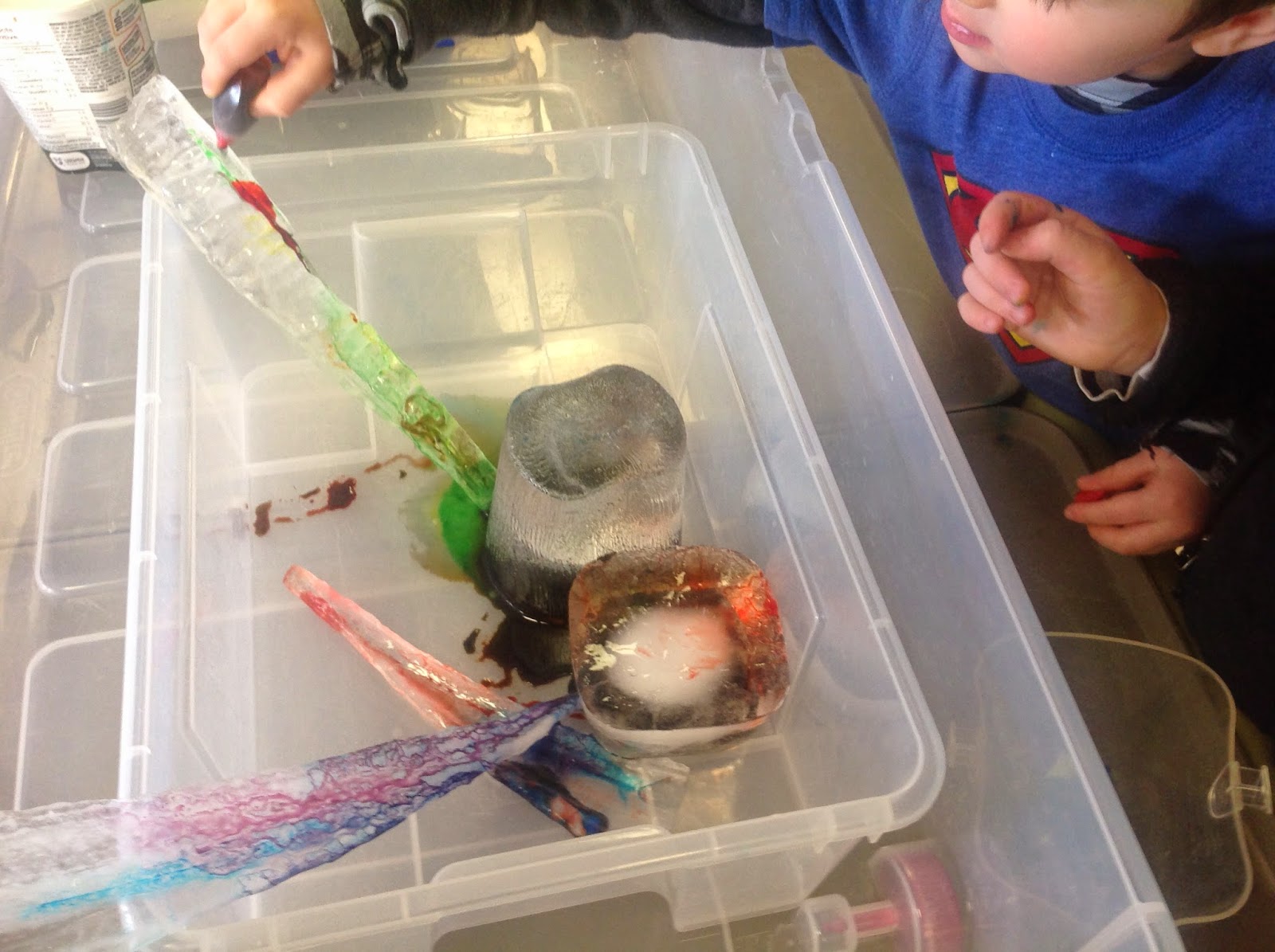
After sharing her question with the class, I placed some food colouring at the ice area with some ice we've been freezing daily for exploration purposes.


Students noticed that the food colouring didn't go through the ice but ran down the side instead. They also saw lines forming on the big ice. O. S. thought it was caused by the food colouring running down the side. 

K. E. and C. D. brought in a few icicles. With permission, they placed their icicles at the ice area so their classmates can explore them further.

Having used salt, and food colouring, students were now thinking of other things they wanted to try on ice.




Stay tuned for our Ice Melting Competition blog post coming soon!

Sunday, 22 February 2015

Making the most of an unfortunate circumstance: Exploring Ice Part 2

Sadly a pipe in our classroom burst due to the extreme cold temperatures. We had some water damage and had to re-locate to another temporary classroom. Since we were already exploring and investigating ice, I decided to take advantage of this situation and use it as a learning opportunity. I asked if I could take the burst pipe to show the students what caused the leak. I suspected that they would be quite interested, as they had been asking a lot of questions about what happened and expressed concern about their work on the wall and portfolios being wrecked. 

I brought the pipe in the next day to show them. I passed it around and listened as students discussed what they noticed, thought, and any wonders they had.

"It might of froze and it started to get freezer and freezer and then the pipe broke because the ice was too strong because it was pushing the metal!" O. S.

"Some metal breaks and some doesn't." Z. G.

"Maybe the water was so cold and some of the cold air came through the window and it got so cold the pipe got a hole in it." C. C.

"It got so freezing outside then it got a medium crack and water started to leak out. The ice was so strong it peeled off the metal and made a leak." M. O.

"Water is so cold it is ice and made it freeze and crack." D. C.

"Maybe the heat wasn't on for the winter and it made the ice break and make a hole." B.K.

"Maybe the water squirted so hard it was so cold outside it made ice in it and caused a leak." J. K.

"I think there is ice in the pipe and water in the middle, and the water was so hard and popped out and started a leak." H. S.

"The air was so cold outside and it froze the water in the pipe and it got so hard and strong it pushed a hole in the pipe." K. W.

"The breeze was so cold and the old pipe broke and the old pipe can't hold it, the breeze broke it." C. D.

"The ice got so big it broke the pipe." O. M.

"Since the pipe is round there was a lot of water there and it made the pipe burst." A. T.


I was surprised by the theories they made about the pipe and how it became broken since I never mentioned anything to them. This made me wonder if any of them experienced a mishap like this at home in some way? 

As a way to further extend their learning about the capabilities of ice, I asked them if they wanted to put some water in a glass jar, set it outside and see what would happen? They were all on board to try.


One students decided to write the steps to our experiment. We also made some predictions of what we thought might happen!

"I think the glass is going to break because the ice will push. It might get too big and then the glass will break. Glass is more fragile than the pipe and so the ice is strong and breaked the pipe and will break the glass jar too." O. S.

"I think the glass will break because ice broke through metal and glass isn't as strong as metal." S. C.

"I think the water will freeze." O. M.

"Maybe the glass will break because the ice is strong." K. W.


The next day we retrieved our experiment from outside and observed what happened!

"The ice was pushing and hitting the jar and it bonged a piece off the jar!" J. K.

"The water turned into ice and made a piece break off the jar because ice is stronger than glass." M. O.

"But metal is stronger than glass. What happens to ice when it freezes? Is it bigger or smaller?" O. S.

"It gets bigger because the ice is stronger than metal and the ice made a hole in the pipe." A. F.

"I think it gets smaller when it freezes. It gets smaller when it melts." P. I.

"I think it gets bigger because ice gets stronger and it depends how long you froze it. It gets bigger because it grows, it broke a piece off the glass." H. S.

Listening to the students, I noticed that they started to discuss the physical change of ice and used their observations to create theories based on the notion that ice either gets bigger or smaller when it freezes.


Once students who want to participate fill a sticky, we will come together and discuss everyone's thoughts and figure out what path it may lead us on!

Sunday, 8 February 2015

"I wonder how the icicles got built?" Exploring Ice Part 1

In keeping up with the cold weather, I introduced the students to a poem about icicles which they were noticing in our school yard and at home. 


The next day I showed the students a picture that Zahra (teacher candidate) took of some icicles she noticed while shopping.


Zahra explained to the students that she took the picture because she was amazed by how big the icicles were! 

That same day, L. B. wrote down a wonder she had about icicles and shared it with the class.

"I wonder how the icicles got built?" L. B.

"Maybe because it was so cold the icicles go bigger and bigger and bigger." K. W.

"Get cold water and we put it like this \/ (showing with hands), and it gets cold and gets bigger and freezes." C. C.

"If it snows, that is water, and it gets colder and it freezes and little icicles come together and starts growing." H. S.

"So when it snows, when it is out there for a long time it starts to melt, then when it drips sometimes when it's so cold it freezes. I know how ice is made because me and my dad build an ice rink in the backyard." O. S.

"Snow and water makes ice and that might make an icicles. One day I put water in the snow and it turned ice." D. C.

"When the rain comes, it gets cold and it freezes and it grows. Maybe when it gets more water and snow it grows." W. E.

The following morning, W. E. and E. E. made ice at home and brought it to school in a bag to share their experiment with their peers!

"I made ice, and how I made it was, last night I got water and I put it in the freezer. It got cold, stuck together then it grew." W. E.

"What did you pour the water in?" Mrs. Ralph

"I poured the water in this bag." W. E.

"You can't hold water. It's liquid." Z. G.

"But it's frozen, and when it gets really cold it starts to freeze and then it becomes a chunk that you can hold it, but if it's just water you can't hold it because it's slippery because it's not cold enough." O. S.

W. E. then asked if the ice chunk could be pass around so that people could feel it. 

"It's slippery!" C. C.

"Cold!!!" M. O.

"It feels watery because it's slippery on my hand!" K. W.

"It's starting to drip! If water drops out of ice, it starts to melt." M. S.

"We can make more ice!" E. E.

What does it look like? Can you describe what you see? Mrs. Ralph

"It's kind of see through white." C. C.

"It looks like milk." B. P. "Cause milk is white." M. S.

"But milk is darker then ice." F. D.

"It looks like a rock because they're both hard." J. K.

"I noticed that they have the same colour as our glass people (glass chess pieces)!" S. C.


"Milk is white and ice is clear!" S. C.

Taking advantage of this learning opportunity, I introduced the words transparent, translucent, and opaque.


The ice chunks were then placed in a bin for continued hands on explorations by students.


The following day, two more students brought in ice from home!

K. W. came to school with a bag full of icicles! 

"My daddy came home and I got the idea. He used a really sharp shovel like a needle and then he holded it and then he jumped and he swinged the shovel and then some of the icicles got cut off and first we had like a treasure hunt and we had to dig for them!". K. E. 

F. D. also brought in ice and explained her experiment to the class.

"I made ice and how I made it is first I put hot water, then I put it in a cup, then I put it in a bag, and then I left it outside." F. D.


The icicles and the ice in the cup were passed around for students to explore.

"It's watery and bumpy." K. W.

"Slippery." C. D.


"I was holing onto it and it almost slipped out of my hand!" J. K.


"It has snow in it and making a little sound, on the top it is translucent and on the bottom transparent." B. K.


"It's cold, bumpy, and smooth." E. E.

"It has some snow on it, and it's kind of grey and a bit of black on it." Z. G.


"It is really really super cold." S. T.


"It smells like dirt." F. D.

"It smells like dripping rain." M. S.


"It smells wet." L. S.


"I see little bubbles in it, I think it's water." L. B.


"It's a shape of a cone and then it grows!." J. K.

"Cylinder." B. K.


"It was transparent, I saw M. S. through it. Not all of it was transparent, some of it was translucent." K. E.


"It looks like a triangle." A. F.


"I hear a sound, a crackling sound. It is cracking because it's not outside anymore. At the bottom is transparent, at the top is translucent." E. E.

"It is crispy at the edge and in the middle it is smooth. There is a crack in the middle and bubbles in the middle, they were water and turned into ice." W. E.


"Why is the ice cup shaped?" C. D.

"How did the bubbles get froze when the water was moving?" W. E.


"I wonder why did the bubbles get frozen when the water was in the ice." K. W.


The students had many observations, theories and wonders. Together we created a chart to place all the information.


The excitement was growing! A few more students brought in icicles and ice made in their freezer at home.

"First my mom breaked the icicle and then we put them in the freezer so they would stay cold and wouldn't melt." C. D.

"My ice is a triangle shape. I made it at home, I got a bag of water and I put it in the freezer and waited eighteen days, and it froze and I couldn't wait to share it with my classmates. I used plain, it was cold because I wanted it frozen solid." M. O.

"I made ice, and how I made it is first I put water in a container and then I put it in the freezer and waited four or five days and it turned into ice. H. S.


All the ice was passed around for further exploration.

"It's transparent because I can see through it." M. O.

"J. K.'s is translucent and opaque." W. E.

"Why does J. K.'s ice look like that and C. D.'s does not?" Mrs. Ralph

"I think because maybe the water, the rain and the kitchen water are different kinds of water because the rain is see through and the kitchen water you can't see through it." W. E.

"Maybe because J. K.'s was in a bag and C. D.'s was outside and J. K.'s came in a chunk and C. D.'s was an icicle." K. W.

"Because maybe J. K. put lots of cold water and maybe C. D.'s icicle might have a little bit of water because it dripped off and was thin and J. K.'s had a lot of water." O. S.


H. S.'s ice experiment

"It is grey and translucent and it feels like ice, slippery and looks like a rectangle." A. F.

"It looks like a triangle and it is cold and slippery like snow." D. A.

"It is cold and flat and looks like a hill." D. C.

"I think maybe it wasn't on a flat surface and that's why all the water went on that side then less water went on the other side." O. S.

"And that's what happened cause I poured water in and it went like that (making a diagonal line with her hand), so when I put it in the freezer it was still like that." H. S.

"When you put it in a container and you put the water, and you put it in the freezer, the cup you put it in it turns into that shape." P. I.


S. C.'s ice experiment

"I put water in my bowl, then vinegar, and then I put cotton balls, and then I put pink food colouring and it turned orange! I wanted to make it colourful and I wanted to know if orange ice turned out to be real and it is!" S. C.

Our orange ice wonder was also passed around for further exploration!

"It's cold and a little heavy maybe because S. C. put a lot of things in it." K. W.

"It's kind of super cold and I see red stuff." M. S.

"It smells like apple juice." B. K.

"It feels slippery." L. S.

S. C.'s colourful ice led to some exciting experiment ideas!

"Lets make ice yellow in the shape of a rectangle!" K. E.

"Purple and a rectangle!" M. O.

"Put food colouring in our ice!" L. S.

"Green food colouring in a square shape!" Z. G.

"Use outside water and put food colouring and see if it is different!" W. E.

"How are we going to get water from outside?" Mrs. Ralph

"Find an icicle and let it melt and use that water." H. S.

"Or let snow melt in a container and put that water in the freezer." O. S.

"Wait until the rain comes." L. S.

"Put food colouring in milk and freeze it!" E. E.

"Get water in a jar and put salt and food colouring and put it in the freezer." W. E.

"Maybe we can make ice from rain and the tap?" A. T.

"How many days or months do we have to wait for ice to melt?" P. I.

What wonderful authentic experiment ideas! Stay tuned as we explore and investigate ice further!