"The Plan" seemed very straightforward and logical to me. It further supported my thinking about inquiry and enabled me to reflect on a strong interest that was starting to ignite in the classroom. The four-steps spoke to me so much that I decided to share the concept with the students and co-construct our bulletin board display to include the headings as a guide during our tower inquiry. Below is our tower inquiry journey thus far. Please note that this is our interpretation.

Sparks (provocations)—Identify emerging ideas, look at children’s interests, hold conversations, and provide experiences (Seitz, 2006).


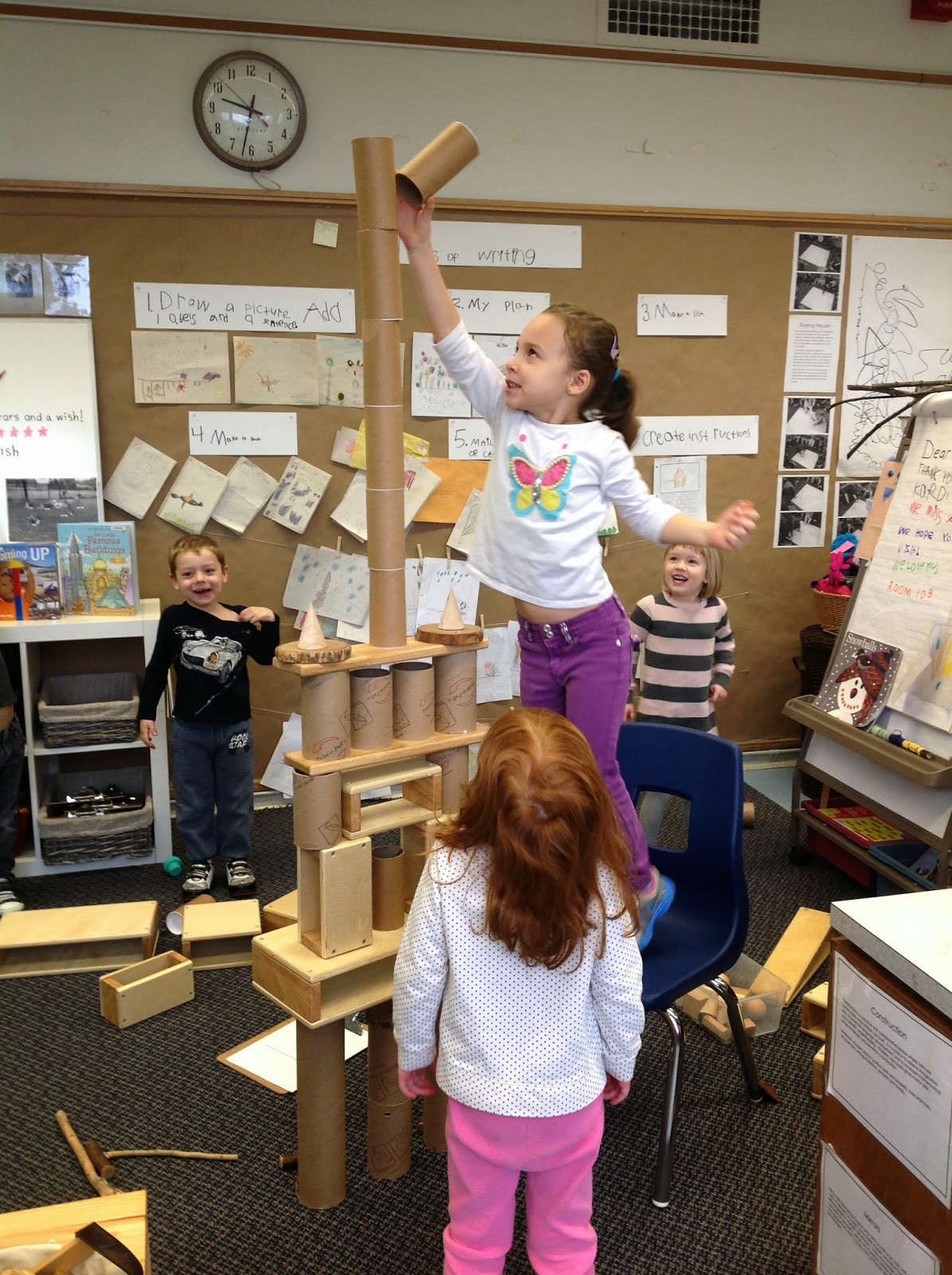


As the interest in tower building continued, students became quite familiar with the names and appearances of various towers around the world. I then decided to start conversations with students as a whole group, during the sharing of their structures, as well as in smaller groups allowing for more in-depth conversations. I started by asking students what they knew about towers and what wonders they had.
I noticed that the students were using the words tower and skyscraper interchangeably. So I decided to ask them the question: Is a tower a skyscraper?
"They make towers strong and tall so they don't fall over." S. T.
"A tower is a skyscraper because it's tall and it almost touches the sky!" Z. G.
"A skyscraper is a kind of building that's called a structure. It depends how tall towers are. If you have a really tall building or structure, it's a skyscraper." O. S.
"But the Statue of Liberty looks like a person, it's not a building." P. I.
"It has doors; it's a statue and a building." Z. G.
"But a skyscraper has to be tall and it has to touch the sky like a tower!" W. E.
"A skyscraper is something that is really tall and has a sharp point at the top." F. D.
"A building has a lot of windows and a skyscraper doesn't have that much." H. S.
"A skyscraper is a really tall building that can touch the sky and has a point so it can scrape the sky." K. W.
"The CN Tower is not the same size as a building." M. O.
Thought about his house and how it's a building.
"The CN Tower is way taller than my house so it's not a building." M. O.
"Yea, my grandma lives in an apartment building and it's smaller than the CN Tower!" O. S.
This was an interesting discussion. Many different aspects were coming out of this conversation. What is a tower? What makes a tower a tower? What is a skyscraper? Is a tower a skyscraper? What is a building? What is a structure? In the end, there seemed to be opposing views by students. Some who argued that towers are little and skyscrapers are big. Others thought towers are taller than skyscrapers. It is not important who is correct but the critical thinking and reasoning they give to defend their theories. We will continue to investigate...
Just a few days ago, a new spark ignited yet another direction of investigation. During a group sharing, O. S. asked to share something she researched with her dad the previous night on the computer. I had no idea what she was going to share, but I loved the fact that her learning and motivation was extended to the home environment and brought back to our classroom. She took out a piece of paper and told us that her dad and her researched how tall the CN Tower was in feet on the computer. As an aside, the students have some familiarity with the measurement in feet, which stemmed from our bat inquiry having had to figure out how high 12 feet was to place our bat box in the spring. O. S. showed me the written note her dad gave her to share with the class. I asked her if she could then write how tall the CN Tower was on our easel so we would remember. I was so excited, as I was hoping this may lead to students inquiring about the height of other towers leading to further explorations and investigations in comparison etc. The pictures below showcase the combined work effort of some students. I showed them how to use the computer and read the number to their friend who was writing on the easel. It was remarkable to step back and see how well they managed on their own. Most importantly it was nice to see how well they supported each other, how driven they were, and confident!


In supporting our current wonders, we will continue to converse, experience, and share new theories that arise from our research on towers.
In December, I started noticing that many students were creating towers at various learning areas in the classroom. Having access to measuring tools (rulers, measuring tape), students were motivated to build towers as high as they could, then measure them to figure out how tall they were. Noticing this interest, I decided to place some books and pictures of different towers found around the world at the Construction Area and see what would happen.
I started noticing that the tower creations became more intricate and involved, and since many students visited some of the towers in the pictures, there was an intrinsic connection to the structures being built.
Conversations—Have conversations with interested participants (teachers, children,
and parents), ask questions, document conversations. Ask “What do we already know? What do we wonder about? How can we learn more? What is the plan?” (Seitz, 2006).
As the interest in tower building continued, students became quite familiar with the names and appearances of various towers around the world. I then decided to start conversations with students as a whole group, during the sharing of their structures, as well as in smaller groups allowing for more in-depth conversations. I started by asking students what they knew about towers and what wonders they had.
What do you know about
towers?
“When people
build towers they start building the bottom first so they can make it stable on
the bottom and make it taller.” O. S.
“People can
go inside the Leaning Tower of Pisa!” K. E.
“We can go
in the Chrysler Building.” E. E.
“At night
you see the elevator of the CN Tower from outside and it looks like a dark blue
car driving up it!” Z. G.
“Lots of
towers look like a triangle so they can put the straight point and make it
stable.”
W. E.
“The Leaning
Tower of Pisa was not straight up, it was leaning.” K. W.
“A
skyscraper has a red light on the top that blinks.” D. A.
“So
airplanes won’t fly in it.” Z. G.
“People that
build stuff build towers.” C. D.
“Every night
the Empire State Building lights up!” W. E.
“A really
tall building is called a skyscraper.” M. S.
What do you wonder about
towers?
“How many
days did it take to build the Burj Khalifa?” O. M.
“How many
towers can you go inside?” O. M.
“I wonder
when the Leaning Tower of Pisa started tilting?” H. S.
“Who makes
the material to build the towers?” E. E.
After asking
this question, students started listing materials used to
build towers.
1.
Metal 6. Cement
2.
Wood 7. Stones,
rocks, pebbles
3.
Glass 8.
Concrete
4.
Paint
5.
Bricks
“How does the Leaning Tower of Pisa not fall down
because it leans?” L. B.
“Why do
towers look different?” W. E.
Opportunities and experiences—Provide opportunities and experiences in both the classroom and the community for further investigation, while documenting those experiences (Seitz, 2006).
With the hopes of furthering their knowledge and supporting their explorations and investigations, purposeful materials and resources were placed at different areas in the classroom enabling students to self select and drive their own research and theories that were of interest to them.
Sharing personal experiences through dialogue and pictures also greatly supported learning. During the winter break, E. E. and W. E. went New York and took many pictures of the different towers they saw and visited. The knowledge they shared and the new information gained by their classmates was amazing and was evident in the various works created by students.
Below is some of the information that was shared by E. E. and W. E. with their classmates through dialogue and pictures:
"The Empire State Building has three elevators and one escalator and at the very top everything looks very small and you can see the Statue of Liberty!" W. E.
"We saw the whole world when we were at the top!" E. E.
"It had lots of windows. Why doesn't the Burj Khalifa have lots of windows?" E. E.
"This is the Chrysler Building, in the daytime the lights don't light up." W. E.
"It has lots more windows than the Empire State Building." E. E.
"It lights up at night to make it look pretty." W. E.
"The Empire State Building was the tallest building because when we were at the top the other towers looked smaller." W. E.
"Why do they all have points at the top?" K. E.
"Because that's how it goes thicker at the bottom and thinner at the top!" H. S.
"And so that when planes fly by they can see the tower!" E. E.
Experiences of exploration and investigation using purposeful materials:


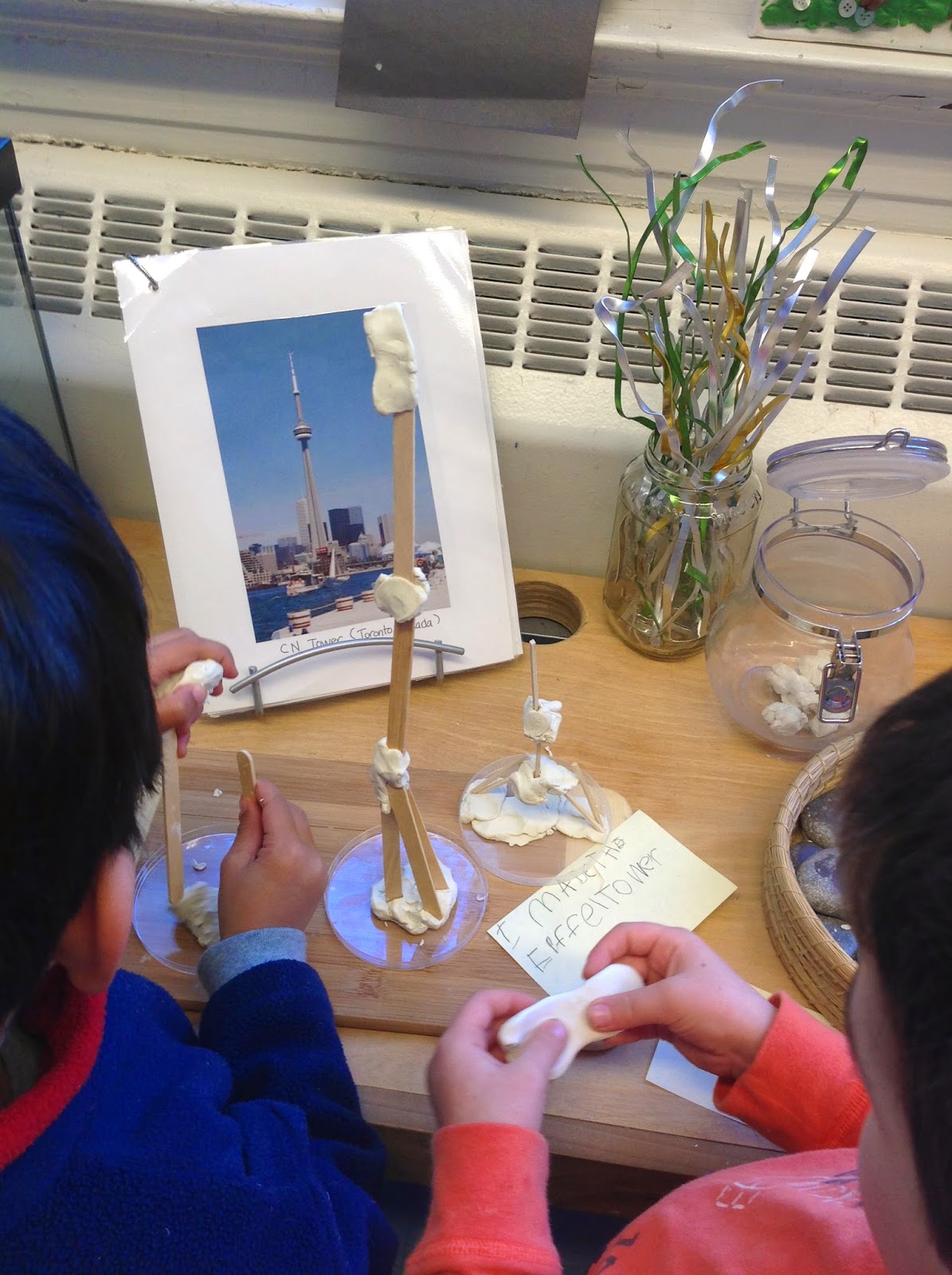


With the hopes of furthering their knowledge and supporting their explorations and investigations, purposeful materials and resources were placed at different areas in the classroom enabling students to self select and drive their own research and theories that were of interest to them.
Sharing personal experiences through dialogue and pictures also greatly supported learning. During the winter break, E. E. and W. E. went New York and took many pictures of the different towers they saw and visited. The knowledge they shared and the new information gained by their classmates was amazing and was evident in the various works created by students.
Below is some of the information that was shared by E. E. and W. E. with their classmates through dialogue and pictures:
"The Empire State Building has three elevators and one escalator and at the very top everything looks very small and you can see the Statue of Liberty!" W. E.
"We saw the whole world when we were at the top!" E. E.
"It had lots of windows. Why doesn't the Burj Khalifa have lots of windows?" E. E.
"This is the Chrysler Building, in the daytime the lights don't light up." W. E.
"It has lots more windows than the Empire State Building." E. E.
"It lights up at night to make it look pretty." W. E.
"The Empire State Building was the tallest building because when we were at the top the other towers looked smaller." W. E.
"Why do they all have points at the top?" K. E.
"Because that's how it goes thicker at the bottom and thinner at the top!" H. S.
"And so that when planes fly by they can see the tower!" E. E.
Experiences of exploration and investigation using purposeful materials:
Theories—Think further about the process. Document questions and theories. In other words, teachers, children, and parents identify something of interest; we discuss what we know about it or what we want to know about it; we experience it or have opportunities to learn about the idea; and then we discuss what we did and either ask more questions or make new theories. We document our understandings throughout the whole process (Seitz, 2006).
I noticed that the students were using the words tower and skyscraper interchangeably. So I decided to ask them the question: Is a tower a skyscraper?
"They make towers strong and tall so they don't fall over." S. T.
"A tower is a skyscraper because it's tall and it almost touches the sky!" Z. G.
"A skyscraper is a kind of building that's called a structure. It depends how tall towers are. If you have a really tall building or structure, it's a skyscraper." O. S.
"But the Statue of Liberty looks like a person, it's not a building." P. I.
"It has doors; it's a statue and a building." Z. G.
"But a skyscraper has to be tall and it has to touch the sky like a tower!" W. E.
"A skyscraper is something that is really tall and has a sharp point at the top." F. D.
"A building has a lot of windows and a skyscraper doesn't have that much." H. S.
"A skyscraper is a really tall building that can touch the sky and has a point so it can scrape the sky." K. W.
"The CN Tower is not the same size as a building." M. O.
Thought about his house and how it's a building.
"The CN Tower is way taller than my house so it's not a building." M. O.
"Yea, my grandma lives in an apartment building and it's smaller than the CN Tower!" O. S.
This was an interesting discussion. Many different aspects were coming out of this conversation. What is a tower? What makes a tower a tower? What is a skyscraper? Is a tower a skyscraper? What is a building? What is a structure? In the end, there seemed to be opposing views by students. Some who argued that towers are little and skyscrapers are big. Others thought towers are taller than skyscrapers. It is not important who is correct but the critical thinking and reasoning they give to defend their theories. We will continue to investigate...
Just a few days ago, a new spark ignited yet another direction of investigation. During a group sharing, O. S. asked to share something she researched with her dad the previous night on the computer. I had no idea what she was going to share, but I loved the fact that her learning and motivation was extended to the home environment and brought back to our classroom. She took out a piece of paper and told us that her dad and her researched how tall the CN Tower was in feet on the computer. As an aside, the students have some familiarity with the measurement in feet, which stemmed from our bat inquiry having had to figure out how high 12 feet was to place our bat box in the spring. O. S. showed me the written note her dad gave her to share with the class. I asked her if she could then write how tall the CN Tower was on our easel so we would remember. I was so excited, as I was hoping this may lead to students inquiring about the height of other towers leading to further explorations and investigations in comparison etc. The pictures below showcase the combined work effort of some students. I showed them how to use the computer and read the number to their friend who was writing on the easel. It was remarkable to step back and see how well they managed on their own. Most importantly it was nice to see how well they supported each other, how driven they were, and confident!
In supporting our current wonders, we will continue to converse, experience, and share new theories that arise from our research on towers.


