Sunday, 7 December 2014

Exploring Measurement

As an entry point to learning about measuring length, I set up a provocation for the students with the the following questions:

Who is the tallest?

Who is the shortest?

How can we find out?

I also placed some non-standard units for length (cubes and Kapla planks) as well as standard units of length (measuring tapes) for added exposure.


As students made their way into the classroom, I sat back and observed. I was excited to see what they would do and use to answer the questions.

A few students read the questions out loud to everyone. They were very excited and quickly started to stand back to back to figure out their height in comparison to their friends. I was surprised that they took a different solution to figuring out the questions than I had anticipated. They didn't use any of the materials I set out. Instead, they worked as a group sorting and lining themselves from tallest to shortest in a line!


I was very proud of the way they self managed and used their critical thinking skills to find the answers to the questions without any guidance. 

But now I wondered how to motivate them to use the materials to measure length. They were no longer interested in measuring each other since they answered the questions posed to them.

I decided to add more to the existing provocation and use their interest of building tall structures as a possible motivator for them to use the measuring materials. I posed new questions:

How tall is your structure?

How can you find out?


They enjoyed using the non-standard units of measurement, but were particularly drawn to the rulers and measuring tapes available. I guided their learning by demonstrating the correct way to use a ruler and measuring tape. They wondered why there were numbers on both sides, so I showed them and explained the difference in spacing between the lines of one side versus the other. I didn't go into deep conversation about millimeters, centimeters and inches, but asked them to choose which side they wanted to use to measure their structures.

After a few days, I noticed that the interest in measuring structures was fading, maybe it wasn't meaningful to them or they didn't see the purpose for it. Instead students started measuring random objects and each other. I took this opportunity to once again change the provocation questions:

What can you measure?

What can you use?


During a group discussion on measurement, H. S. came up with a wonderful theory!

"If you're tall you have a bigger shoe and if you're smaller you have a smaller shoe."


I asked the students how we can find out if H. S.' theory is correct? They began measuring their shoes and then each other to find out. I felt this was a perfect opportunity to discuss the importance of using the same measuring material (constant non-standard unit) when comparing length. 

"Just as it is important for students to have opportunities to measure a length using different units, they need to measure different lengths using the same unit. This will give them measurement data that they can readily compare." 
-Big Ideas from Dr. Small, pg. 93 


I started thinking about the exposure my students have had to measurement thus far. I couldn't help but feel like something was missing. Something I try my best to do as an educator is make a link between learning in the classroom and it's applicability to our daily lives and the world around us. So I decided to ask the students the simple question:

"Why do we measure?"

Responses:

"So we know how tall you are." F. D.

"Cause they don't know how old you are and they're gonna wonder how tall you are." B. K.

"My cousin is five and I am four and I am taller than him." Z. G.

"We measure how tall we are." S. T.

"So we know how tall we are and how many bones we have because so our doctor knows how much we have grown." S. C.

"If some people are working and are putting in a new door, they have to measure how tall the door is so they know if the door will fit in the doorway." C. C.

"They use a measuring scale that measures height." M. O.

"How do we measure the weight of the class?" W. E.

"When my brother was in my mom's tummy, he came out before me, but I'm taller than him." E. E.

"So people know how big you are cause people want to know how tall you are." K. W.

"You can measure their weight with a measurer. It has a line thing and it's at my doctor's. S. C.

"He wants to know if you're too much weight or not enough weight. It's called a scale. It touches your head and a silver thing goes down." J. K.

"There's different kinds of scales because at my home I do have a scale and you just step on it and it tells you how heavy you are." H. S.

"B (brother) was born first and he's taller than me." M. S.

"I think if you are born first, whoever is born second they are bigger." E. E.

"It depends on who is born first in your family. A (sister) is six and she was born first and she's tallest." M. O.

"I was born first and I'm taller than my brother." C. C.

"But Z. G. is four and I'm four but he's taller?! M. S. is four but he's taller than me still!" E. E.

"J. S. is five and I'm four and I'm taller." O. M.

"D. A. is five and Z. G. is four and Z. G. is taller!" W. E.

"Maybe people get born at not the same time, that makes a difference of how old people are?" O. S.

The students' responses gave me a better idea of the knowledge they had about measurement. They seemed to be aware that measuring also entailed mass and time, not just length.

The discussion of age and its relation to height also continued to be debated by the students. This led to the co-creation of a chart displaying their name, age, and height. 


After the chart was completed, we studied the data together. Students noticed that being older didn't necessarily mean they were taller. Someone who is older can be shorter than someone who is younger.  

"There is examples for both theories! It tells me maybe both are right!" Z. G.

"Maybe families are different sizes because not everyone is born at the same time." O. S.

"Maybe different families get different things?" M. O.

"I think it depends on how much you eat and how much you grow." H. S.

I am glad I asked the question, "Why do we measure?". It provided insightful responses and generated a purposeful investigation that was meaningful to the students and motivated them to further develop their measuring skills. 


Sunday, 23 November 2014

Bat Box Building!

I set out the bat box wooden pieces on a table and posed the question: Can we build a bat box? 

As students slowly made their way into the classroom, I stood back and observed their interaction with the materials and with each other.


Having prior knowledge about bat boxes from the bat inquiry, the students were very excited to be able to interact with a real one. 

Cooperatively they took turns observing, touching, and manipulating the wooden pieces of the bat box. They noted the different shapes, textures, sizes, and number of pieces. Each wanted to try and put it together and find the right fit. When one student had trouble, it was nice to see the support given by a peer in figuring out the best fit.

I then showed the students a video of how to build the bat box as an extra visual which outlined the steps nicely.


The students took advantage of the materials at the Art Studio, Light Table, and Discover Area, which further supported exploration, experimentation and allowed them to display their knowledge using a variety means.


It was time to build the bat box! We read each step of the instructions as we attempted to build the box. E. E. reminded us to use four nails for each piece we put together. The students were wonderful in pointing out which piece came first, second, etc. With guidance, some students hammered nails and fasten the pieces together. It took great precision and self-control to hit the nail straight. I must admit, I was having more trouble than some of the students!


The students cheered as we completed the bat box! It was nice to see the accomplishment they felt working together to complete a goal.

The students were aware that the bat box would not be placed outside until spring, when the bats returned from hibernation. But they did learn that the bat box needed to be 12 feet off the ground. As I read this to them, a few students started to use their feet, and thought this was what 12 feet meant. O. S. suggested we research on the computer what feet meant. Luckily, we started learning about measurement, where I placed rulers out among other measuring tools, therefore, students had some familiarity with them. I explained that 1 foot is the same as 1 (30 cm) ruler. O. S. and P. I. started counting our rulers but we did not have enough. I went and collected a few more from a few other classes, and handed them to O. S. and P. I. 


I observed as the girls placed all twelve rulers out in a line. To remember this length, I gave them some yarn and suggested to them to cut it the same length so we have it when it's time for us to hang the bat box.

I am amazed at the amount of learning that has come from this bat box. It was a project that served a purpose and the students were very motivated to accomplish their goal of building it.


Sunday, 9 November 2014

Further learning about bats: Part 2 of our bat inquiry!

The students and I have been reading many books about bats. One book in particular, a fiction book titled: Stellaluna demonstrated some differences between bats and birds. This wonderful story is about a little fruit bat named Stellaluna who happened to get separated from her mother and ends up in a nest with three baby birds.


After reading the book a few times, as well as watching a video of the story, the students had a few more wonder questions about bats.

One amazing question by B. P. "How are bats born?", started a wonderful discussion among the students. 


"Bats get born first from a mouse and then they go inside a tree and then it's really dark and the mouse turns into a bat!" W. E.

"Maybe Stellaluna gets born from her mommy! It looks the same as it does now." H. S. 

"I think baby bats are born alive from the mother bat." J. S.

I told the students I wasn't sure about the answer to this question. With all the wonderful books and ideas they had, I asked them to continue to think and look at our classroom books to help guide us in figuring out the answer.

One morning, K. E. brought in a book from home about bats which he wanted me to read to the class.


As I read the book to the students, we found some very interesting information! Bats are mammals, they have fur and have babies born alive. Birds, have feathers and their babies are born from eggs.


A. F. also found this great information in one of our bat books to add to our investigation!


We decided to add this new information to our Venn diagram that showed the differences between bats and birds.

Over the next few weeks, I noticed some students were fascinated by these pictures found in many of the bat books we had at the Discover Area.


I decided to read one of the books that contained the pictures they were interested in. As we came to one of the pages, I asked them what they thought this picture was all about?

"It looks like noise." D. A.

"It's bouncing off." P. I.

"What's bouncing off?" Mrs. Ralph

"The noise from the moth bounces off the moth and back to the bat." J. S.

"The noise from the moth bounces back to the bat and tells the bat there is food near by and GULP! The noise that the moth makes bounces off from the ears of the bat!" O. S.

"Wow, how did you come up with this theory?" Mrs. Ralph

"I thought about it and looked in the books." O. S.

"They hear the sound the bug makes and fly and try and get to eat it." E. E.

"In dark caves bats don't use their eyes, they use their ears. I looked at K. E.'s book and it said that." W. E.

I read some more from the books and we found out bats use sonar to guide their way in the night to locate food. This is called echolocation!

"I think the bat squeaks through their noses and then the further away the echolocation, it takes longer for the sound to reach or come back to the bat means the bug is farther away." J. K.

To support further learning, we continue to enjoy listening to this informative and very catchy song about echolocation!


We have wonderful fiction and non-fiction books about bats, but I also wanted to find a way to connect students to bats in a meaningful way. I was able to find some wonderful videos about real bats flying, eating and being taken care of after injury. A wonderful organization I started exposing the students to was the Toronto Wildlife Centre. Their website contained wonderful pictures and videos of the wildlife animals they help that are sick or injured. One day I stumbled upon this picture and immediately showed the students!


Right away they noticed the picture of the bat. I told them that the TWC had 12 Big Brown Bats and 1 Small-Footed Bat in their care. Many wondered why they were there? They also noticed something written in pink marker. 

"What does the writing in pink say?" P. I.

I read the word endangered to them. Then I asked them what they thought that meant?

"I think it means they're in trouble?" H. S.

"There's not so much bats. They're like dinosaurs, not anymore." W. E.

"Maybe they bonged into a tree and are in trouble?" E. E.

"Maybe they don't have a home?" C. D.

"Maybe they don't know how to fly?" P. I.

"Maybe bad guys want to eat the bats?" L. S.

"Maybe there's not a lot of caves?" D. C.

"Maybe there's too many bats in the cave and not enough room for the other bats." B. K.

I also showed this video by the Canadian Wildlife Federation to the students. It is advanced in the language but I wanted to support them further in understanding why some bats were endangered.


After viewing the video, I asked the students if they wanted to share something they heard or learned from the video. 

J. K. hand went up right away, "I heard the word fungal disease."

I was excited that this information was heard and discussed.

A few days later O. S. brought in a fabulous book about bats from a trip she took with her mom to the public library


As promised, I read the book to the class and it was filled with amazing information supporting our video about bats being endangered.

Below are some of the theories that the students formulated from the book "A Place For Bats". 

"Disease means that something is sick. My mom told me. I was talking about bats and I told her 'what does disease mean?' and she said that something is sick. Fungal means that something is sick." E. E.

"When bats get sprayed by pesticide on a farm, it can die. In PEI, my mom told me to shut the window because there was pesticide sprayer moving. You use it to spray bugs on the plants." J. K.

"You spray it on fruits and plants so bugs don't eat them." F. D.

"Bats can't eat the bugs that are full of pesticides, if they do , they will die." P. I.

"Pesticides that chemicals that makes bugs sick and when bats eat them they get sick and die." O. S.

"Maybe in pesticides it grows fungal disease and makes bats sick and die?" J. K.

"Pesticides have chemicals that hurt the bats bodies." W. E.

"Maybe salt water grows fungus because it doesn't look like regular water. It has white stuff growing." M. S.

"The fungus has chemicals and the chemicals grow white nose syndrome. Their nose is getting white." J. K.

"Why is the Little Brown Bat endangered?" M. S.

"Fungal disease means that bats are in danger and they're sick." E. E.

"When bats get White Nose Syndrome, sometimes they can't fly. There's no more bats and when they sleep in their cave, the pesticide goes inside and all the bats will die." P. I.

"There's not much places for bats to live because people are cutting down trees and building and they get tired and there's no where for them to sleep." O. S.

"In the nighttime when they (wind turbines) spin, the bats can get dead because they fly into them." J. K.

We also had a great presentation from the Toronto Wildlife Centre. As experts, they were able to build on the students' existing knowledge about bats and answer further wonder questions they had.


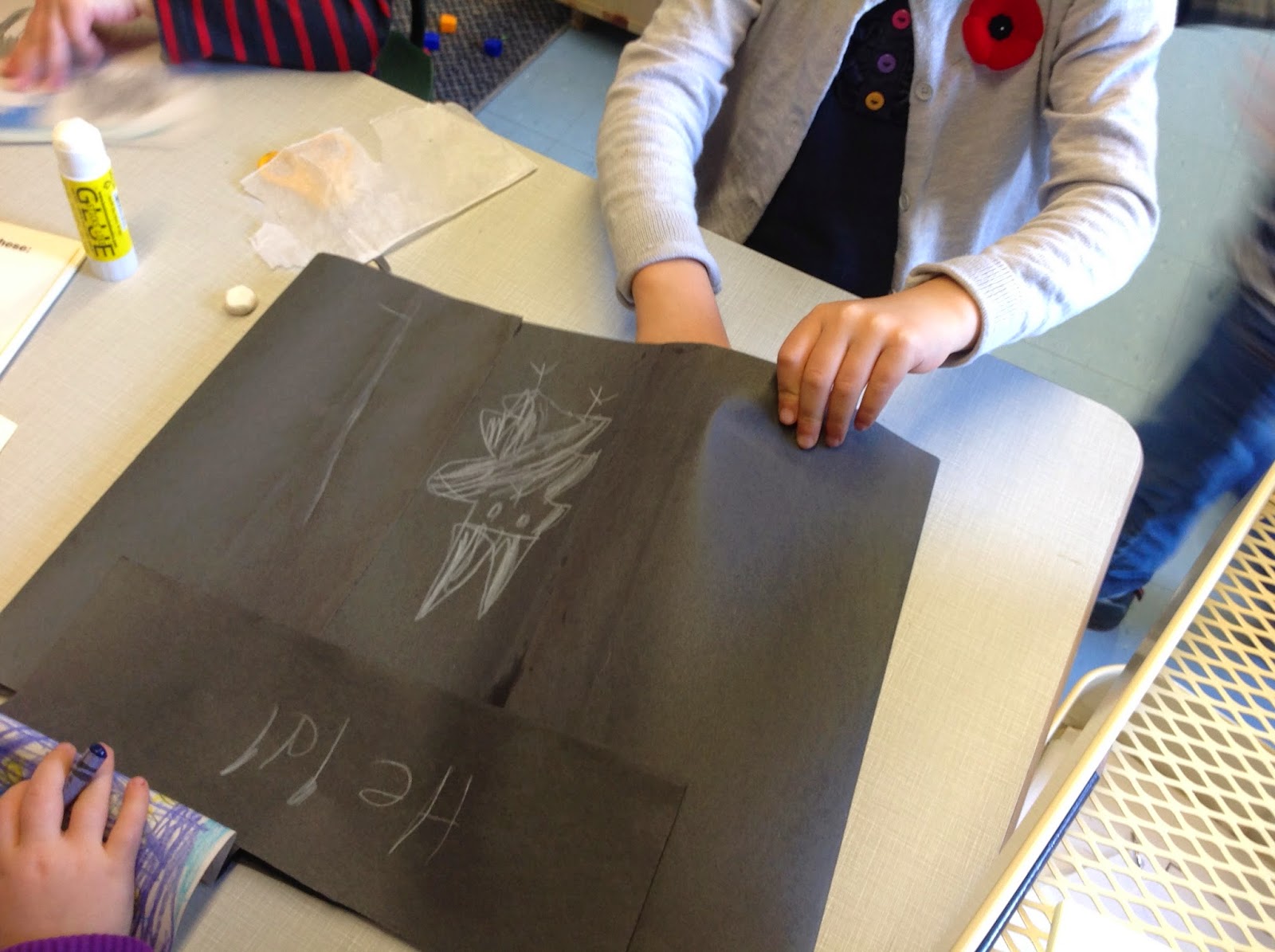
The students were able to think critically and apply their knowledge from the videos, books, TWC presentation, and class discussions, in creating theories of their own about the many bat wonders they had. Their learning was made visible in the creations they made during our Thinking and Learning Time.


 Pointing at the bat's nose that appears to looks like the fungus in the book.

"We made a bat house." A. T. 


"The bats couldn't go because of the wind turbines." K. E.  

Making a bat box.  

The white cubes are bats that have White Nose Syndrome. 


Drawing a diagram of a bat and adding labels. 


Creating books about bats.


Students started noticing pictures of bat boxes in many of our bat books. They have been building them at various learning areas. Stay tuned!