Please use the images below as a way to ignite conversations with your child at home.
"Tell me and I forget. Teach me and I may remember. Involve me and I learn." Benjamin Franklin
Wednesday, 21 May 2014
Monday, 12 May 2014
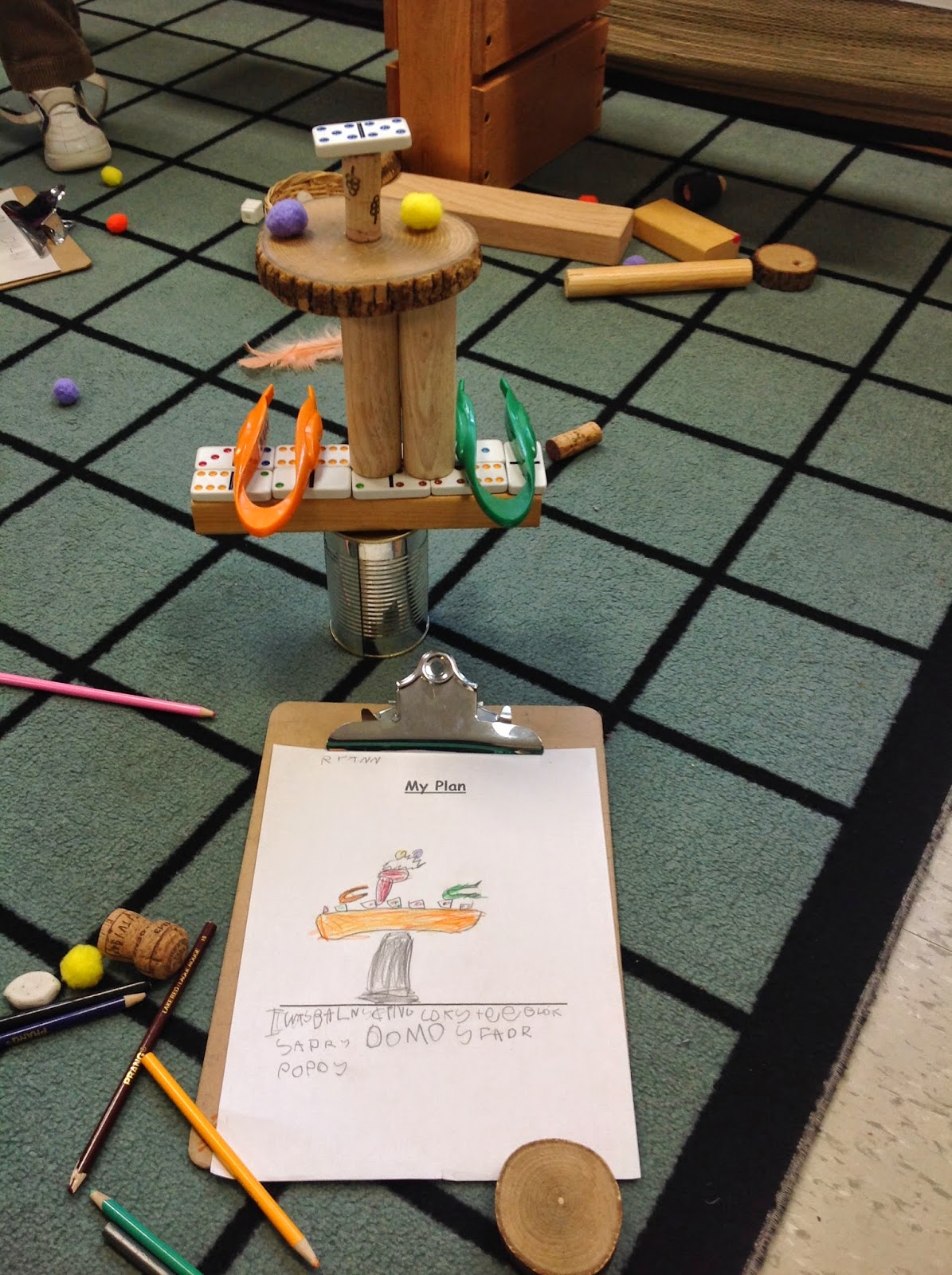
What can you balance? Exploring Mass!
Sarama and Clements stress that “the importance of well-planned, free-choice play, appropriate to the ages of the children, should not be underestimated. Such play…if mathematized contributes to mathematics learning” (2009, p. 329).
Recently, various materials were set up at the math carpet for students to explore and investigate mass and balance. The only instruction was a sign that read "What can you balance?" I stepped back and watched as the students immediately engaged with excitement! The following pictures document the students learning from the past few weeks.
To build on the students' knowledge, we read the book "Balancing Act" by Ellen Stoll Walsh.
During the reading of the book, there was a lot of discussion about the content.
"It's balanced because the two salamanders are the same weight and the two mice are the same weight, so it's the same, so it's balanced." H.S.
"If you take one of the mice off and move the other to the middle, the salamanders will balance." E.H.
"Oh no! A frog came and she said the one with the three will go down because three is more than two and they are heavier!" R.W.
"If one mouse goes in the middle and three on each side, the middle one will stabilize the scale." G.B.
Some students then decided to retell parts of the book by creating their own scales and adding the characters.
Reading the book inspired my own question to ask the students: "If E.S. went on one side of the scale, and A.T. went on the other, would they balance?" Mrs. Ralph
"No because A.T. is lighter. Maybe A.T. and C.D. could go on one side because they are the same height?" A.M.
E.S. decided to demonstrate his and A.M.'s thinking using blocks at the balance area.
During our Thinking and Learning Time, I was intrigued by what E.S. was doing. I asked him to explain his thinking.
He responded by telling me his was using one big block to be him, and two small blocks to be A.T. and C.D.
"It will balance like this I think." E.S.
Recently, various materials were set up at the math carpet for students to explore and investigate mass and balance. The only instruction was a sign that read "What can you balance?" I stepped back and watched as the students immediately engaged with excitement! The following pictures document the students learning from the past few weeks.
To build on the students' knowledge, we read the book "Balancing Act" by Ellen Stoll Walsh.
During the reading of the book, there was a lot of discussion about the content.
"It's balanced because the two salamanders are the same weight and the two mice are the same weight, so it's the same, so it's balanced." H.S.
"If you take one of the mice off and move the other to the middle, the salamanders will balance." E.H.
"Oh no! A frog came and she said the one with the three will go down because three is more than two and they are heavier!" R.W.
"If one mouse goes in the middle and three on each side, the middle one will stabilize the scale." G.B.
Some students then decided to retell parts of the book by creating their own scales and adding the characters.
Reading the book inspired my own question to ask the students: "If E.S. went on one side of the scale, and A.T. went on the other, would they balance?" Mrs. Ralph
"No because A.T. is lighter. Maybe A.T. and C.D. could go on one side because they are the same height?" A.M.
E.S. decided to demonstrate his and A.M.'s thinking using blocks at the balance area.
During our Thinking and Learning Time, I was intrigued by what E.S. was doing. I asked him to explain his thinking.
He responded by telling me his was using one big block to be him, and two small blocks to be A.T. and C.D.
"It will balance like this I think." E.S.
Friday, 2 May 2014
Making our learning visible!
Our Rock Inquiry documentation board display! Created with the support of the students!
Inquiry places students' questions and ideas, rather than solely those of the teacher, at the centre of the learning experience. Students' questions drive the learning process forward. The inquiry-based approach encourage students to ask and genuinely investigate their own questions about the world. The students' learning is facilitated further by providing a variety of tools, resources, and experiences that enable learners to investigate, reflect, and rigorously discuss potential solutions to their own questions about a topic the class is studying.
Natural Curiosity: A Resource for Teachers. Page 7
Subscribe to:
Posts (Atom)